
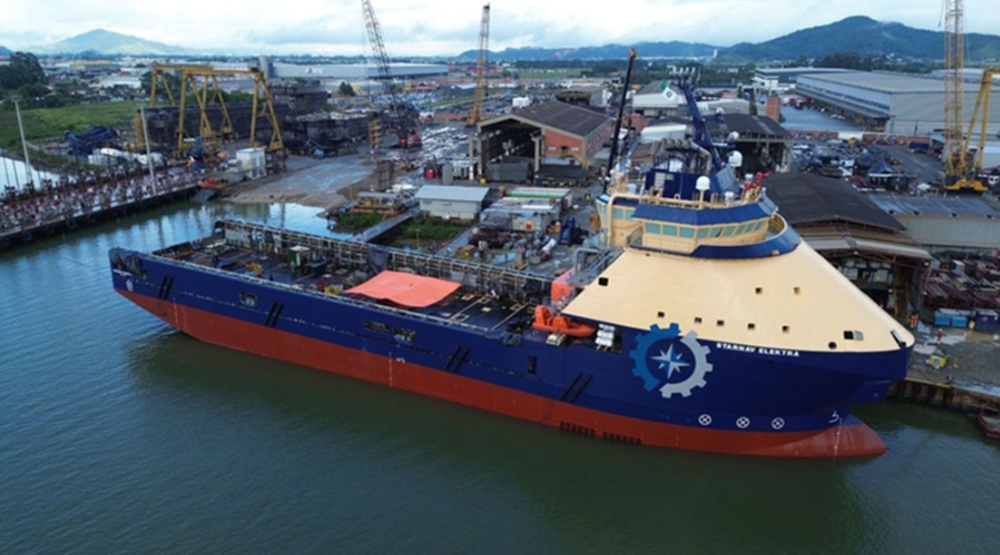
Hybrid offshore support vessels (SOVs) with battery power packs and engines were first adopted in Europe. Batteries have also been retrofitted on American vessels – such as those owned and operated by Seacor Marine – and are a key feature in new designs ordered by Capital Offshore. Now, one of the leading OSV owners in Brazil is following suit.
Launched in March 2026 and expected to enter service later in 2026, Starnav Elektra is the first of a new class of platform supply vessels (PSVs) and oil spill response vessels for Starnav that will bring the advantages of hybrid propulsion to the Brazilian market for the first time.
As first highlighted in the November/December 2025 issue of OSJ, built by Detroit Brasil, Starnav Elektra is a 5,500-dwt PSV, 92.1-m vessel and the first of what will be a total of 10 Brazilian-design and built battery-equipped vessels.
Built to ABS class, the DP2-class vessel will carry the class notations ESS-LiBATTERY and HYBRID, and have SUSTAIN-1 notation, demonstrating the vessel’s adherence to the UN Sustainable Development Goals. SUSTAIN-1 indicates the vessel complies with the relevant requirements in the ABS Guide for Sustainable Notations for oil and chemical pollution, waste streams, coastal and marine ecosystems, air emissions, efficiency and performance monitoring and ship recycling.
Due to enter service working for Brazil’s state oil company Petrobras, Starnav Elektra has a 1,322 kWh battery power system, supplied by WEG. The overall design and capacity of the battery pack was defined in close collaboration with the oil major, and will provide the vessel with peak shaving capability, enabling the ship’s engines to operate within their optimal operating range, with batteries providing more energy when peak loads are required.
Batteries will also enable another mode of operation, acting as a form of ‘spinning reserve,’ so that the ship can run on fewer generators, with batteries taking the extra load. Both will reduce fuel consumption and emissions from the vessel and reduce engine operating hours and maintenance.
Additional details of the vessels were revealed in July 2027 by Rolls-Royce, which is to supply mtu Series 4000 M33S engines to power gensets for new vessels.
Rolls-Royce is contracted to supply a total of 40 engines for the new vessel series. Each ship will be equipped with four gensets, each powered by an mtu 16V 4000 M33S engine, coupled with a selective catalytic reduction system from Hug Engineering, enabling them to meet IMO Tier III specifications.
In a statement, Rolls-Royce said the mtu 16V 4000 M33S engines “are engineered for long running hours, reduced maintenance levels and have proven longevity in offshore operations.” Delivering 2,080 kW at 1,800 rpm, the engines provide rapid load response and operational reliability and were designed for use in on-board power generation and diesel-electric drives.
Starnav chief executive Carlos Eduardo Pereira said of the new ships, “These new vessels mark a significant step forward for the Brazilian OSV industry. By integrating mtu engines within a hybrid propulsion system, which includes a dedicated battery bank and the flexibility to use lower-emission HVO fuel, Starnav is demonstrating a tangible commitment to both environmental responsibility and operational efficiency.”
When delivered, all of the hybrid newbuilds will operate under 12-year charter contracts with the state-owned oil company, supporting offshore logistics operations. They are due to enter service between 2026 and 2028.
Robban Assafina is now on WhatsApp channel. Click Here


