
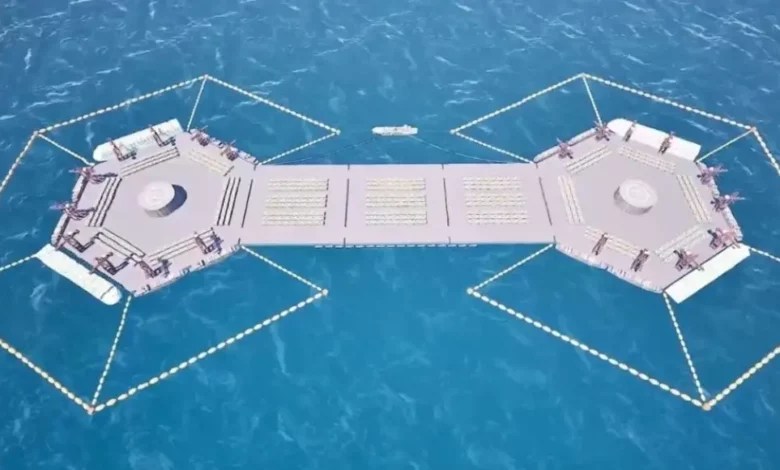
Chinese shipbuilding company Jiangnan Shipyard has introduced an ambitious offshore logistics hub concept that combines a floating container terminal, nuclear-powered energy facility, and green-fuel production platform in a single maritime structure.
Presented during the Posidonia exhibition in Athens, the concept reflects the shipping industry’s growing focus on innovative solutions to accelerate decarbonisation and rethink the future of global maritime infrastructure. More than a century of maritime history has bound ports to fixed pieces of coastline, deeply tying them to cities, local labour, and state regulations. Even the most automated terminals are pinned to places.
Jiangnan breaks that link, imagining a modular hub moored wherever deep water and shipping demand meet, moving the port system offshore.
Decarbonisation needs demand rapid emission cuts, and tweaks will hardly cut it. Putting power generation, fuel production, and cargo handling in one place reduces energy losses, cuts out the need to transport green fuels from land, and provides clean power right where ships sail.
This setup tackles a tough question: how do we hit green targets while moving more boxes?
Consider a new operational reality. A large container ship no longer squeezes into a coastal hub. Instead, it unloads at a nuclear platform 200 nautical miles out. Smaller feeder ships shuttle the boxes to and from gateways. The main ship avoids port congestion and shallow waters, while power for the hub and its ships is generated right on site alongside zero-carbon fuels.
Shifting a core pillar of global trade offshore rewrites the industry’s risk profile. Mainline voyages could be optimised for pure sailing time rather than berth windows in ports. However, putting everything on a single offshore platform creates a concentration of energy, cargo, and risk. If an asset like this fails due to a severe storm, a cyberattack, or a geopolitical clash, the fallout would cripple regional supply chain networks.
Technically, the concept is a three-part engineering challenge. Physically, it must survive heavy weather in deep water. Energy-wise, its molten-salt reactor must safely pump out electricity and heat to run the terminal and synthesise alternative fuels. Digitally, an operating system must run the whole operations in real time while keeping hackers out.
The biggest roadblocks, however, are not technical. They are regulatory black holes. Floating nuclear plants sit between current laws. A platform that is simultaneously a nuclear site, a chemical plant, and a container terminal clearly challenges current regulations. Which country licenses a reactor operating outside national borders? How do customs, labour laws, and port inspections apply? Who is liable and pays the bills if a nuclear accident spills across multiple coastal zones?
Right now, there is no international rulebook for this innovative concept. Preventing technology from outrunning governance requires swift and pragmatic steps. Speed of decarbonisation is of essence. Port states and the IMO should first designate sovereign-neutral sandboxes in deepwater zones to live-test automated transhipment synchronisation and safety protocols under joint jurisdiction. Concurrently, the industry could establish a dedicated nuclear oversight body to draft standardised, cross-border licensing templates and liability insurance schemes. Finally, port operators and carriers need to standardise open-architecture digital twin networks to dynamically manage weather-driven offshore crane movements.
China’s concept is both a reminder and an invitation. Ports may not stay pinned to the coast forever. The challenge is whether the industry collaborates to build a secure framework or lets state-backed pioneers write the rules of future trade.
Source: Splash247
Robban Assafina is now on WhatsApp channel. Click Here


