
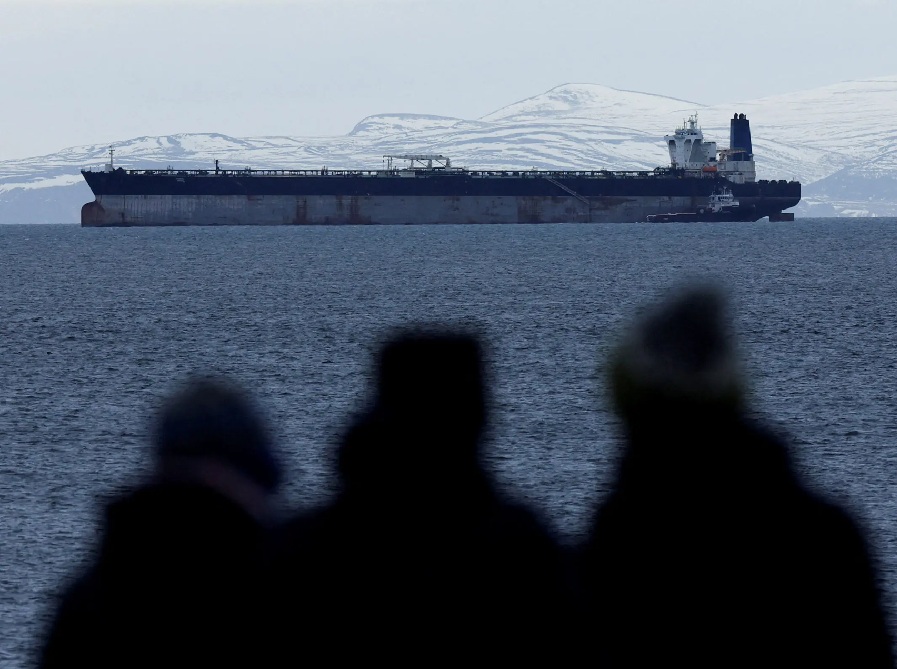
In 2026, the Baltic Sea countries, France, India, and others have inspected and detained more shadow-fleet vessels than in prior years.
In response, Russian military vessels have begun escorting shadow vessels through the English Channel and Baltic Sea.
Some Iranian shadow vessels have been able to sail despite the war in Iran and Iran’s blockade of the Strait of Hormuz.
A not insignificant number have also managed to evade the United States’ blockade of Iranian ports.
Since the end of 2022, the shadow fleet—a large and growing group of ships that sail outside the official shipping system—has been in the news because of its role transporting sanctioned Russian oil. In March 2026, Iranian shadow vessels began attracting attention as well, as they have been able to keep sailing despite one and then two blockades amid the war in Iran.
Although there is no official definition of shadow vessels—also known as the dark fleet, the ghost fleet, or the parallel fleet—they are disproportionately old and typically feature these characteristics:
- Transport sanctioned cargo
- Have opaque ownership
- Lack insurance of the International Group of P&I Clubs (protection and indemnity associations)
- Are often aging, in poor condition, or both
- Frequently conceal their movements
In some ways, it is not surprising that the shadow fleet has emerged in recent decades: It has arisen in parallel with the rules-based international system, which came into being in the decades after World War II, with the early participation of the shipping sector. When countries violated the rules-based international order and, as a result, were put under economic sanctions by other nations, they resorted to the shadow fleet for imports and exports. South Africa used shadow vessels during the apartheid era. Countries such as Iran, Venezuela, and North Korea have relied on shadow vessels for years, even decades.
These are, however, relatively small economies. When Russia turned to the shadow fleet following Western governments’ introduction of a $60 per barrel price cap on Russian oil in December 2022, the shadow fleet grew dramatically. Whereas it had previously encompassed an estimated two hundred ships, in November 2023, more than 1,600 oil and product tankers had operated in the “opaque market” since January 2021.
Since then, the shadow fleet has continued to operate. In August 2025, broker BRS estimated that there were 1,140 shadow oil tankers, more than 18 percent of the global oil tanker fleet. Other ship categories have also seen the number of shadow vessels grow.
The large shadow fleet has come to pose a significant problem for coastal states and legally operating vessels. These risks include collisions and other accidents; spills of oil and other hazardous substances; and the threats to the maritime order itself that arise when a significant minority of ships do not uphold rules. In the Baltic Sea, the route most commonly used by the shadow fleet, these risks have raised especially serious concerns.
Shadow vessels have also damaged undersea cables, sometimes under mysterious circumstances. On Christmas Day of 2024, the Cook Islands-flagged shadow tanker Eagle S struck four data cables and one interconnector cable in the Gulf of Finland, the Baltic Sea’s eastern end. The incident caused considerable losses in connectivity and power provision, as well as financial losses for the operators; in the case of EstLink 2, the interconnector, its operators estimated the cost of repairs at about €60 million ($69 million).
In addition, the shadow vessels continue to pose a severe environmental risk. In a simulation of an accident in February 2026, a research center in Geesthacht, Germany, calculated how a hypothetical spill of 48,000 tons of Urals crude oil would spread over thirty days. The simulation projected devastating effects, even with such a relatively limited spill. (The tankers that carry sanctioned oil from Russia’s Baltic ports—key ports of departure for Russian oil—through the Baltic Sea are typically of the Suez-max class, with capacity of 160,000 deadweight tons.)
In recent months, Danish pilots—the Western Europeans with the closest proximity to shadow vessels—have also reported noticing a deterioration in the quality of the seafarers on board. This is hardly surprising, as seafarers who have a choice to board a legitimately sailing vessel would clearly do so, not least for their own safety.
Measures to tackle the shadow fleet
As soon as it became apparent that Russia was turning to the shadow fleet for its exports of sanctioned oil, Western governments tried to stem the traffic. The first, and primary, way they have done so in the months and years since is through sanctions of individual vessels. As of early 2026, the European Union has listed nearly six hundred shadow vessels by adding them to the list “of those subject to a port access ban and ban on provision of a broad range of services related to maritime transport.” More than four hundred ships have been sanctioned by the EU, the United Kingdom, the United States, and Canada.
In December 2024, twelve European countries—Britain, Germany, Poland, the Netherlands, five Nordic nations, and the three Baltic states announced that they would begin checking suspected shadow vessels’ insurance certificates. (Under international maritime rules, vessels are required to have P&I insurance, and there was evidence that shadow vessels were sailing without proper P&I insurance as there were very few alternatives to the coverage offered by the International Group of P&I clubs, which are based in Western countries and thus subject to Western laws.) Six of the countries—Britain, Denmark, Sweden, Poland, Finland, and Estonia—would begin carrying out inspections in the English Channel, the Danish straits, the Gulf of Finland, and the Kattegat between Sweden and Denmark. “If the ships do not cooperate, next steps will be taken: they will be put on a list for prohibition, or they will be boarded in certain areas,” Estonian Prime Minister Kristen Michal said at the time. By April 2025, Estonia had requested proof of insurance from more than five hundred vessels; by January 2026, the UK government had done so from more than six hundred suspected shadow vessels.
The Baltic Sea states, as well as the UK, have also increased patrolling. In the Baltic Sea, the patrolling is also conducted by Commander Task Force Baltic, a German-led initiative comprising sailors, naval aviators, marines, ships, and aircraft from thirteen NATO member states, to which the NATO-initiated Baltic Sentry, a “multi-domain activity,” has been added.
In December 2024, Finland broke new ground by boarding the Eagle S. The ship, which had just struck five undersea cables in the Gulf of Finland, was navigating in Finland’s exclusive economic zone (EEZ) and was approaching other fiber-optic cables and the EstLink 1 interconnector, which runs between Estonia and Finland. The Finnish Border Guard instructed the ship to enter Finnish territorial waters, where Border Guard and police officers boarded her.
Some flag-of-extreme-convenience nations have removed shadow vessels from their registries. For example, the government of Eswatini appears to have discovered that a private outfit was running a fraudulent ship registry in the country’s name; the government subsequently began deflagging ships registered by the outfit.14 Although plenty of flags of extreme convenience (the author’s term) are still willing to flag shadow vessels, being deflagged is an inconvenience for shadow vessels and their owners.
In April 2025, Estonian authorities detained the Kiwala, a shadow vessel that claimed to be flagged in Djibouti but was, in fact, sailing without flag registration. (The detention occurred after Estonian authorities had instructed the ship, which had been navigating in Estonia’s EEZ, to enter Estonian territorial waters.) An inspection showed that the Kiwala had numerous deficiencies. After most of them had been rectified and Djibouti had agreed to flag the ship for a few days, the Kiwala departed. The incident marked the first time a shadow vessel has brazenly sailed without flag registration.
Escalation in shadow fleet behavior
The behavior by the Kiwala and her owner demonstrated an increased willingness among shadow fleet participants to violate rules including cardinal ones such as flag registration, apparently because they believe that they will not be punished for doing so. Several weeks after Estonia’s detention of the Kiwala, Estonian authorities tried to detain another known shadow vessel, the Jaguar, in the country’s EEZ. This time, however, the ship did not obey the Estonian instructions to move into Estonian territorial waters. Instead, a Russian fighter jet responded by breaching Estonian airspace.
Soon after the Kiwala and Jaguar incidents, Finnish authorities warned that the Russian Navy had begun escorting shadow vessels through the Gulf of Finland. Such escorts appear to have been formalized in January 2026, when the Russian government’s maritime board decided to take measures that would, from the Russian perspective, protect merchant ships linked to Russia. “Issues related to ensuring the safety of navigation on strategic maritime routes are considered. Particular attention is paid to problems associated with violations of international maritime law by unfriendly states,” the Maritime Board said in a statement announcing the measure.
The Russian escorts mark a new twist on maritime order. Traditionally, navies have occasionally escorted merchant vessels in waters plagued by pirates or other forms of violence. That occurred, for example, during the 1980s “Tanker War” between Iran and Iraq, when the United States escorted US-flagged vessels from the Persian Gulf through the Strait of Hormuz. Naval escorts of rule-breaking vessels through the waters of coastal states seeking to uphold maritime rules are a highly concerning development.
At the time of writing, the Strait of Hormuz dominates global news for another reason having to do with the maritime order. When the United States and Israel launched a war against it on February 28, 2026, Iran responded by threatening global shipping in the crucial and narrow strait; some merchant vessels were even hit by missiles. This rendered the strait de facto blocked and caused prices of oil and other crucial exports from the Persian Gulf to surge.
The de facto closure remained even after a ceasefire appeared to have been agreed, as transiting the strait remained subject to Iranian permission and, reportedly, the payment of substantial tolls. The ships successfully leaving the Persian Gulf included numerous shadow vessels transporting Iranian oil to international destinations. Like other shadow vessels, shadow vessels transporting Iranian cargo typically have flags of extreme convenience (the author’s term) such as Tanzania and Gabon.
On April 13, the United States imposed a blockade of its own, blocking ships navigating to and from Iranian ports. According to the US Central Command, during the first 48 hours the blockade, involving more than ten thousand US servicemembers, more than twelve ships and more than one hundred aircraft, successfully blockaded all ship traffic to and from Iranian ports. When BBC Verify, the BBC’s verification unit, checked this assertion using open-source intelligence, it could not be confirmed. Lloyd’s List reported on April 20 that several shadow vessels had evaded the blockade since it was imposed.
The number of shadow vessels sailing without valid flag registration has, in turn, grown rapidly since the first cases were observed in early 2025. The shipping-industry publication Lloyd’s List reports that the number of false-flagged ships in the Baltic Sea quadrupled during the second half of 2025, and in February 2026 the investigative news outlet Follow the Money reported that more than five hundred vessels were sailing without valid flag registration.
Irregular passengers
In 2025, Danish pilots on shadow vessels crossing the Danish straits began seeing individuals on board who were not listed in crew documentation. “We’re seeing uniformed personnel carrying the camouflage uniform of the Russian Navy. When I’m on these ships, I do what I can to see the crew list. I want to see what I’m dealing with,” Bjarne Skinnerup, a Danish pilot, told this author in September 2025. But, he said, the uniformed officers were not on the crew lists. He suspected unofficial passengers might be mapping Danish infrastructure. Since then, the Swedish Navy has said that it, too, has seen unlisted personnel on shadow vessels in the Baltic Sea.
It is not known what duties these passengers have. The very fact that they are on board without their names appearing in any documentation is, however, a violation of maritime rules and illustrates shadow vessels’ increasing brazenness.
Further measures to tackle the shadow fleet
On New Year’s Eve 2025, the Finnish Border Guard detained the cargo ship Fitburg—suspected of striking cables in the Gulf of Finland—after instructing the ship, sailing under the flag of Saint Vincent and the Grenadines, to enter Finnish territorial waters. At the end of January 2026, French authorities detained the shadow tanker Grinch—which was sailing without a valid flag registration—between Spain and Morocco. A few weeks earlier, French authorities had detained the former Kiwala, the ship Estonian authorities had detained in May 2025. She had been renamed Boracay and purported to be flagged by Benin, but refused to provide evidence of her flag registration when instructed to do so by the authorities; in March 2026, the ship’s captain, a Chinese national, was convicted in absentia of failing to obey the authorities’ instructions.
In the early months of 2026, similar detentions continued. In February, India boarded three Iranian shadow vessels some one hundred nautical miles off Mumbai in the Arabian Sea. These were the first interdictions against shadow vessels by India, a major recipient of oil transported by Russian shadow vessels, and may have been a gesture of goodwill toward the United States, which had, earlier that month, reduced its 50 percent tariffs on India to 25 percent.
In early March, Belgian forces, with some French air support, boarded the Ethera, a tanker sailing under a false Guinean flag, in Belgium’s EEZ in the North Sea. A few days later, the Swedish Coast Guard detained the Caffa, a cargo ship also sailing under a false Guinean flag, in Swedish territorial waters. A few days after that, the Swedish Coast Guard detained another vessel sailing under a false flag. In both cases, the Swedish authorities detained crew members on suspicion of document falsification. On April 3, the Swedish Coast Guard detained yet another shadow tanker, the false-flagged Flora 1, which was sailing off Sweden’s southern coast and had already caused an oil spill off the Swedish island of Gotland in the Baltic Sea. On April 11, the Swedish Coast Guard boarded the Panama-flagged bulk carrier Hui Yuan of its southern coast. Although the Chinese-owned ship is not a ghost vessel, she too had been violating maritime rules by dumping Russian coal residue into the Baltic Sea on her way from Ust-Luga to Las Palmas in Spain.
In March, the Irish government gave the Naval Service legal powers to board shadow vessels, though none have yet been boarded. The UK has also announced it will detain shadow vessels but has not yet done so. It has, however, provided support to French authorities in the detention of at least one such vessel.
Danish waters, a crucial passageway for vessels bound for Russian Baltic ports, saw 292 crossings by sanctioned vessels in 2025. That number is similar to observations in 2023 and 2024. Danish authorities have recently introduced innovative means to ensure these ships have a basic level of seaworthiness, and they have done so by taking port-state control to the sea. Port-state control (PSC) is the inspection of vessels by port officials when ships dock. In the international shipping system, ports are the de facto enforcement body insofar as one exists. Shadow vessels, however, travel through the Baltic Sea without docking at non-Russian ports.
That has prompted the new Danish measure. “We have introduced port-state control out at sea as a shadow fleet countermeasure. That means that sanctioned ships are going straight through, because we’re no longer giving them the possibility to get service at anchor since they face the risk of control. We did port-state control in this way on 122 ships last year,” said Brian Wessel, director-general of the Danish Maritime Authority. “But we don’t detain a lot of ships; five in 2025. We also check all the data with other countries and insurance companies, which means that we have a lot of data and a strong picture of the whole route, also outside Danish waters.” While Denmark’s small number of detentions may seem surprising given the considerable traffic through the country’s waters, it is perhaps understandable, as Russia has proven it is willing to exact revenge against detentions. Such behavior by Russia—and potentially other countries—puts smaller nations wishing to detain shadow vessels at a distinct disadvantage; every detention requires enormous courage because Russia can decide to retaliate anywhere, against anything, using any means.
Shadow vessel developments outside the Baltic Sea
The shadow vessels used by Iran, Venezuela, and North Korea have gained less attention than ones transporting Russian cargo—unsurprisingly so, as there are far fewer of them. In December 2025, however, the United States imposed a “blockade of all sanctioned oil tankers going into, and out of, Venezuela” and deployed Coast Guard vessels to the Caribbean, near Venezuela, to enforce the blockade. Experts from the United Nations Office of the High Commissioner for Human Rights noted that “there is no right to enforce unilateral sanctions through an armed blockade,” but the blockade remained and the US Coast Guard seized two shadow tankers.
In early January 2026, the Venezuelan shadow vessel Bella 1 broke through the blockade and began making her way across the Atlantic—chased by US Coast Guard and Navy vessels. While en route, she changed her name to Marinera and, more crucially, she changed her flag status, from a false Guyanese registration to Russian flagging. A Russian Navy ship and submarine arrived to escort her. In the waters between Iceland and the UK, US forces boarded and detained the Marinera. Although the United Nations Convention on the Law of the Sea (UNCLOS) affords nations the right to detain ships sailing without flag registration outside their territorial waters, and the United States has a policy to act “in a manner consistent with its provisions relating to traditional uses of oceans,” the Marinera could point to its Russian flag registration. Had the Russian vessels decided to intervene, the situation would have escalated dramatically. US marines and sailors boarded another vessel several days later. Since then, the US has detained more Venezuelan shadow vessels. All were boarded outside US territorial waters, where UNCLOS would have given the United States the undisputed right to board.
Another development in shadow-vessel traffic unfolded after Iran effectively closed the Strait of Hormuz in the first week of March 2026. That meant that the tankers that transport oil, gas, and other commodities to international destinations could no longer leave or enter the Gulf. The week before the US-Israel attacks began, 38 percent of global crude oil, 29 percent of liquefied petroleum gas, 19 percent of liquified natural gas (LNG), and a variety of other cargoes passed through the Strait of Hormuz. That weekly flow translates to an average of 129 ships per day.49 The following week, only between three and six ships transited the strait each day, primarily shadow vessels transporting Iranian oil.50 Presumably they had received assurances that Iranian forces would not target them. The war against Iran had thus become a lethal risk for legally sailing vessels but an advantage for Iranian shadow vessels, another development undermining the maritime order.
Effect on the shadow fleet
By early 2026, a strong dialectic was becoming clear within the shadow fleet: Baltic Sea coastal states—and some others, including France, Belgium, the United States, and India—were becoming more assertive in tackling the fleet, and shadow vessels, their crews, and owners were becoming more brazen.
In most cases, the coastal states acted in full compliance with UNCLOS. The actions by the United States, though, were more controversial as they were fighting fire with fire: combatting maritime rule violations with means that were themselves not fully compliant with maritime rules. As Stephanie Connor, a nonresident senior fellow at the Atlantic Council’s GeoEconomics Center, noted:
Although US authorities have purportedly filed warrants to seize dozens more tankers linked to the Venezuelan oil trade, only two warrants have been unsealed to date: authorizations for the seizure of the M/T Skipper (previously known as the Adisa) and the Bella I (now known as the Marinera), both of which were sanctioned for their involvement in supporting Hezbollah and the Quds Force, one of the branches of Iran’s Islamic Revolutionary Guard Corps. … Sanctions alone do not authorize the seizure or confiscation of property.
Indeed, the US government used alleged actions related to terrorism—not sanctions evasion—as the legal basis for its pursuit of the Skipper and the Bella 1. From a US legal perspective, alleged terrorism-linked activities gives significant jurisdiction for civil forfeiture.
Regarding the dramatic seizure of the Bella 1/Marinera, Rob McLaughlin of the University of Wollongong and Australian National University, and Conor McLaughlin of the Australian National Centre for Ocean Resources and Security observe that the US government’s rejection of the Bella 1/Marinera’s en route reflagging to Russia is difficult to accept given
Russia’s confirmation of this transfer. They add:
It is of course possible that the United States has other information that undermines the Russian claim. But on the publicly available information at the moment, the Russian claim of flag state jurisdiction, and thus protection rights over the Marinera, based on fulfillment of Russian domestic law requirements for registration and the limited international law approach to genuine link, appears to be effective.
Another development plays a role in the evolution of the shadow fleet: the price of oil. Until March 2026, the price had been comparatively low—so low that, in January 2026, the coalition that imposed the price cap in December 2022 lowered it from $60 to $44.10 per barrel. On December 31, 2025, Brent crude averaged $61 per barrel. Still, the lower price meant Russia had to export more oil to reach the desired revenue. Wessel describes the impact:
The number of Russian shadow vessels is not decreasing but increasing, because with the oil price down 30 to 40 percent the Russians are pressured and need to export more. It’s also increasingly difficult for them to operate their shadow fleet, and therefore they have to broaden it and to get more ships to export the same amount. Chinese and the Indians are still buying Russian oil. But the hassle Russia has in getting its oil around the world is increasing.
I wouldn’t have said this three, four months ago, but now I can say that our efforts are working and it’s really difficult for the Russians, and they’re getting less revenue for their oil.
That is, of course, precisely what the price cap was designed to achieve.
But the oil market has changed since the author interviewed Wessel on March 4, 2026—with the price of oil rapidly rising as a result of the de facto closure of the Strait of Hormuz. By early April, it had reached $109 per barrel, which made oil transport on shadow vessels extremely lucrative. (The announcement of the ceasefire on April 7 caused the price to drop, but as this report is finalized on April 10, the ceasefire appears fragile, and the oil price is rising once again.)
In response to the global oil crisis triggered by the war in Iran, the United States lifted its sanctions on Russian oil. At the time of writing, this means that legally sailing vessels can transport Russian crude above the price cap without violating US rules, though this would still be a violation of the price cap imposed by the G7 and the EU.
Increased Russian links to the shadow fleets
For the first nearly two and a half years of reliance on the shadow fleet, Russia did not acknowledge its links to it. That changed with Estonia’s attempted detention of the Jaguar and the Russian Air Force’s menacing intrusion into Estonian airspace. Since then, Russian military vessels have, as previously noted, begun to regularly escort shadow vessels through the Baltic Sea and the English Channel.
Russia has also formalized its links to the shadow fleet in other ways. While in the early months and years shadow vessels mostly sailed with illegitimate or useless insurance certificates, by early 2026 official—but sanctioned—Russian insurers were increasingly underwriting shadow vessels transporting Russian cargo. In late February 2026, around one-third of all oil tankers crossing the Baltic presented insurance certificates from sanctioned Russian or Russian-linked insurers.
Russia is also beginning to flag more tankers. The Russian Maritime Register of Shipping, itself under EU sanctions, “is preparing to identify and inspect approximately 80 tankers in the near term, with the aim of re-registering them under the Russian flag,” Euromaidan Press reports, citing Ukraine’s Foreign Intelligence Service. The vessels included in the plans are currently flagged in the Seychelles (thirty-five ships), China (twenty-three), Azerbaijan (thirteen), and Samoa (eight), with additional tankers registered to owners in Vietnam, India, the United Arab Emirates, and the Marshall Islands, the news outlet reports. It is unknown how many of them are shadow vessels, but the fact that Russia plans to flag more tankers suggests it is committed to continued export of oil under any circumstances and is planning to take action against coastal states trying to detain tankers.
Unconventional responses to shadow vessels
Ukraine is the Russian shadow fleet’s main victim, as proceeds from the oil exported by the shadow vessels fund Russia’s war against Ukraine. Unsurprisingly, Ukraine has long sought to combat the Russian shadow fleet, and starting in 2025 it has done so in unconventional ways. In November 2025, drones thought to have been fired by Ukraine struck the shadow tankers Kairos and Virat off the Turkish coast in the Black Sea. The following month, drones also thought to have been fired by Ukraine struck the Oman-flagged shadow tanker Qendil, en route to Port Said in Egypt, in the Mediterranean, some 2,000 kilometers from Ukraine. The same month, the Comoros-flagged shadow tanker Dashan was struck—again reportedly by Ukrainian drones—near the Russian port of Novorossiysk.
In March 2026, the China-bound shadow vessel Arctic Metagaz, which was carrying Russian liquefied natural gas and navigating with its automatic identification system turned off, exploded off the coast of Malta. Russian authorities blamed the incident on Ukrainian drones. The attack put the ship adrift and it was on the verge of sinking, which posed an “imminent and serious” ecological threat, European officials warned. On April 2, authorities in Libya—into whose search-and-rescue waters the ship had drifted—announced that a towing operation had failed and that the ship was “completely out of control at sea.66 In late March, Ukraine struck the oil and gas terminal in the Russian port of Ust-Luga on two occasions using long-range drones, the Security Service of Ukraine (SBU) announced. The attacks caused serious damage and fire to the port, which caused serious disruption to Russian oil exports.67 It also caused a significant backup of shadow vessels in the Gulf of Finland.
While understandable from a moral and national security perspective, the Ukrainian attacks pose a dilemma for policymakers from Europe and other countries allied with Ukraine, as they appear unlawful and could be used by Russia as a pretext for further escalation. Indeed, in mid-March 2026 a top Russian official said Russia is considering deploying naval “mobile firing groups” to escort merchant vessels.68
Conclusion
Baltic Sea coastal states, the countries most affected by the shadow fleet, have made considerable strides in tackling the dangerous and disruptive fleet. They have done so to uphold maritime order and protect their waters from accidents that could pose significant harm to other ships and to marine life, and for the most part, their actions have been in full compliance with UNCLOS.
Regrettably, they now face a situation in which shadow vessels, their crews, their owners, and the Russian state do not comply with coastal states’ enforcement of maritime rules but instead opt for escalation. Such escalation involves even more brazen behavior by the ships as well as menacing escorts and other “protective” activities by the Russian state. The shadow fleet’s new behavior and Russia’s involvement in it may, in fact, be the most pronounced example of the breakdown of the rules-based international order—even amid proliferating rule violations in different parts of the world.
Detentions of shadow vessels by the United States undermine these activities. Though there is no doubt that Venezuela has relied on shadow vessels, especially for exports of oil, the US pursuit of Venezuelan-linked shadow vessels has gone to the limit of or beyond what is permitted under UNCLOS. Although the United States has not signed UNCLOS, it has long adhered to it and, in fact, acted as the key protector of several of its pillars, most especially freedom of navigation. A more constructive approach might have been to work with the countries whose ports the Venezuelan-linked shadow vessels use, or whose waters they traverse, to push for proper port-state control or detention.
Even so, coastal states and other UNCLOS signatories should remain firm in their commitment to rules-based enforcement of maritime rules. Enforcement that violates UNCLOS would trigger a race to the bottom.
Robban Assafina is now on WhatsApp channel. Click Here


