
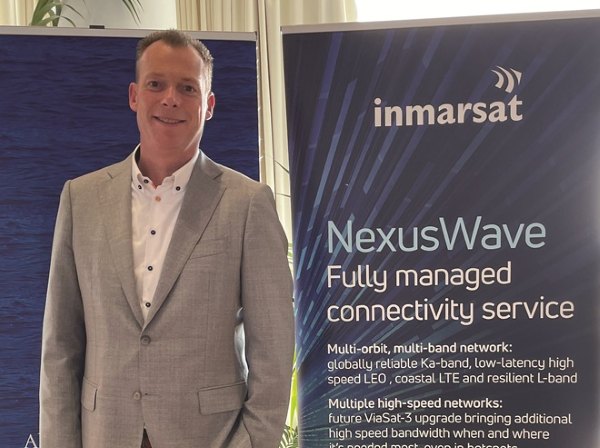
For decades, Inmarsat has led the evolution of maritime communications. As shipping becomes more digital, data-driven, and sustainability-focused, the company continues to redefine connectivity through innovation and global partnerships. Its latest advancement, NexusWave, unites multiple networks into one intelligent, high-speed solution in the aim of powering the next era of smart, connected, and sustainable maritime operations.
Robban Assafina had an interview with Dennis Winterswijk, Regional Director EMEA, Inmarsat Maritime, to explore how the company is driving the next chapter of maritime digitalization, sustainability, and operational excellence. Inmarsat has been a driving force in maritime connectivity for decades.
How would you describe the company’s strategic vision today, especially as global shipping becomes increasingly digital, data-driven, and sustainability-focused?
Given global shipping’s increasing use of digital, data-driven and connected solutions to meet its operational business and crew needs at sea, vessels are coming to resemble floating offices and homes, and maritime connectivity requirements are evolving as a result. Inmarsat’s strategic vision centres on facilitating this transition – and is embodied by its bonded connectivity service, NexusWave.
Combining Global Xpress Ka-band, low-Earth orbit, LTE, and resilient L-band networks in one fully managed bonded connectivity solution, NexusWave delivers the power of multiple services with the convenience of working with a single, trusted maritime connectivity partner.
Unparalleled speeds, global coverage, unlimited data, and secure-by-design network infrastructure keep data-driven processes and digital applications running smoothly regardless of the vessel’s location or operational requirements. This results in an office and home-like connectivity experience that helps operators overcome the challenges and seize the opportunities of a fast-changing industry – to pursue their digitalisation, sustainability, and crew welfare initiatives with confidence.
With the rapid growth of IoT and AI applications onboard vessels, how is Inmarsat integrating advanced analytics and automation into its service ecosystem?
Inmarsat is embedding AI as part of its move towards ‘connectivity intelligence’, where the technology already plays a behind-the-scenes role in NexusWave, particularly in its delivery of a smarter, more reliable, and more responsive experience for customers. It is used to focus capacity supply where and when demand is greatest, to ensure that NexusWave bandwidth is aligned to what matters most on board – whether related to crew welfare, business-critical applications, or other ship operations.
Another example of how Inmarsat uses AI is in analysing vessel-level demand trends and usage patterns. This allows the company as a managed service provider, to make well-informed, proactive recommendations on how customers can optimise their connectivity, helping them stay ahead of their needs rather than reacting as those needs evolve.
How is Inmarsat engaging with local and regional partners, particularly in the Middle East, Africa, and Asia to expand its footprint and deliver tailored connectivity solutions?
Building strong relationships with local and regional partners has always been one of Inmarsat’s key strengths. In pursuing a global approach, Inmarsat benefits from local insight, improved market access, and smoother regulatory approvals. Meanwhile, customers worldwide can count on tailored, high-quality connectivity solutions and close support – right on their doorstep.
Inmarsat’s reports, including the Future of Maritime Safety, have revealed rising challenges in vessel safety and emergency response. How is the company using its global network and data insights to proactively address these risks?
Alongside Maritime London, Inmarsat Maritime runs a maritime safety working group, SEA-CARE, which brings together shipping industry stakeholders, regulators, and UK government representatives to discuss findings from Inmarsat reports and other data sources with a view to tackling persistent safety challenges.
Already, SEA-CARE has identified anonymised data sharing as a means of overcoming the industry’s traditional reluctance to share safety information that could shed light on the root causes of incidents. The working group has also pinpointed crew welfare surveys as a helpful resource for developing a more holistic understanding of maritime safety beyond what can be gleaned from Inmarsat’s GMDSS distress call data alone.
What strategies has Inmarsat adopted to strengthen its presence and partnerships in fast-growing maritime markets such as the Middle East, where demand for smart ports and digital logistics is on the rise?
The launch of NexusWave has been well received in markets, like the Middle East, where demand for smart ports and digital logistics is on the rise.
For example, roll-on/roll-off (RoRo) cargo shipping company Sallaum Lines, which has a strong presence in the Middle East recently upgraded to NexusWave as part of a proactive growth and digitalisation strategy. With Inmarsat’s solution, the company benefits from the reliability, high speeds, and low latency it increasingly relies on to facilitate data collection, analysis, and advanced monitoring across its 14-vessel RoRo fleet, which includes six newbuilds.
Looking ahead, how do you envision the role of satellite connectivity evolving with the development of autonomous vessels, smart ports, and integrated supply chains?
The development of autonomous vessels, smart ports, and integrated supply chains will only emphasise the need for high-speed, always-on connectivity with built-in security and managed performance levels.
In this context, Inmarsat NexusWave represents a future-proof connectivity service. Built for today but with tomorrow’s challenges and opportunities in mind, the fully managed solution supports uninterrupted data transmission, bandwidth-intensive processes, and advanced digital applications.
Moreover, as part of a long-term technology roadmap, Inmarsat is committed to enhancing NexusWave’s capabilities over time. The forthcoming launch of the ViaSat-3 Ka-band network, for instance, is set to deliver increased capacity and bandwidth in line with evolving requirements.
Ultimately, as maritime operations become increasingly complex, organisations will place ever-greater importance on proven reliability and long-term certainty when choosing a connectivity partner.
|
:To read the full content, click on the following link Robban Assafina, Issue 100, Nov/Dec 2025, Maritime Host, pg. 75 |


