
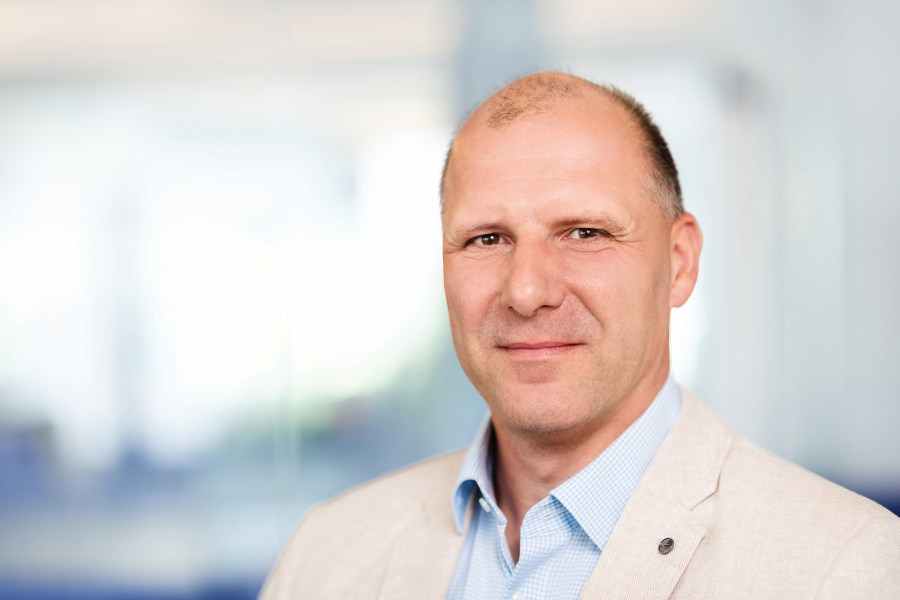
In an exclusive interview with Robban Assafina at ADIPEC 2025, Axel Schulz, CEO of the Aquametro Oil & Marine, discussed the company’s pivotal role in helping shipowners optimize vessel performance and reduce emissions. He also shared insights on Aquametro’s growth strategy in the Middle East, its advanced monitoring and performance-analysis systems, and the evolving landscape of maritime emissions regulation.
How do you perceive ADIPEC, and what is the significance of attending this year?
What we see is that ADIPEC is growing every year and gaining more importance for us as well. We are getting more contacts and, of course, we now have more references over the years. Our reputation as Aquametro has increased, and we receive many visitors who already know our company and come directly to talk with us. We also see investors coming from the entire Middle East, mainly the UAE, but also Saudi Arabia, Kuwait, Qatar, Bahrain, and others.
What key solutions or products are you primarily showcasing?
This year, we are mainly focused on showcasing our monitoring and performance-analysis systems. We provide added value to clients, not only by tracking fuel consumption but also by offering KPIs and emission values, whether these values need to be reported or simply used internally. This gives shipowners a clear overview of their vessels’ performance. Our systems are highly appreciated because they deliver accurate, trusted data. That is the main benefit we bring to our clients.
Recently, over the last two or three months, we started hearing many global players in the maritime industry talking about pausing the emissions trajectory.
Was this expected? And what do we expect from the IMO as we approach the previously set targets?
We were not completely surprised by the results of MEPC 83, because there were already concerns about how well the system was developed. When you see the analysis of the MEPC session, there are still many questions about how to handle the details. So the system may need revision in order to reach a status that everyone can accept.
The system must remain simple enough for everyone to understand. If it becomes too complex, people will struggle, and that’s already happening with the EU system. We expect a pause, there may be a delay of one or two years, maybe even three, but it will definitely come back on the table.
You invest a lot in awareness-building, not only product promotion. What is the importance of this for shipowners?
Shipowners must be aware of what is coming. Even if deadlines are delayed, big changes will still happen. It’s not only about climate change, it’s also about fee systems that will influence the market and drive efficiency.
Efficiency is always important commercially, and the commercial side will ultimately drive the technology. But if the system only introduces fees and burdens without offering any motivation or benefits, it becomes difficult for shipowners to accept. On the infrastructure side, expectations for alternative fuels, biofuels, ammonia, methanol, were higher than what we actually see today. Biofuels can use existing infrastructure, but ammonia and methanol require entirely new infrastructure.
This takes years to build, and it must be available worldwide, not only at a few ports.
There has been a lot of marketing for alternative fuels like methanol, which are not easy for ships to adopt. Is there a gap between regulators and the realities faced by shipowners and operators?
Yes, there is a gap. There is competition among fuels, and all alternative fuels are more expensive, not just the fuel itself, but also the vessel installation, maintenance, and infrastructure.
As long as shipowners can operate on conventional fuels at a lower cost, they will continue doing so. We also see that the newbuilding trends in China shifted back toward conventional vessels after a temporary boom in alternative-fuel vessels.
Just announcing a 2050 zero-emission target is not enough, currently it is not supported by real conditions.
Your GreenBlend system helps reduce emissions. Do you advise shipowners to invest in available solutions now rather than wait for future infrastructure?
Yes, of course. Everyone can already invest in certain solutions today. With our GreenBlend system, for example, shipowners can blend biofuels depending on what is available, some use B100, others use B24. Asia and Europe have different approaches, but biofuel blending is already practical and reduces emissions. For smaller shipowners, these solutions make even more sense because alternative-fuel vessels have high capital and operating costs, and their infrastructure is still limited.
Do you see it as more realistic for the existing global fleet to invest in available solutions now, rather than wait for newbuilds that can operate on alternative fuels?
Yes, exactly. It is much easier to upgrade existing vessels with solutions that are already available. Converting an existing ship to run on an alternative fuel like methanol is extremely complex and costly. Major stakeholders in the market have confirmed that operating vessels on such fuels comes with very high operational costs.
We also have to meet higher safety requirements, and many additional components need to be ATEX-approved. So the challenge is not only the price of the fuel itself; maintenance and operational expenses are also significant.
What should we expect from AOM next year, and what is your strategy for the region?
We want to achieve more significant growth in the Middle East. In this region, we have made a strong entry into the market and established excellent references with Aramco, ADNOC, and many other major players. Meanwhile, more partners are recognizing the value we bring.
We aim to expand beyond the UAE and Saudi Arabia into Kuwait, Oman, and other countries where interest is increasing. We work with all types of vessels, including fisheries, offshore vessels, and large commercial ships. This market continues to grow, and we anticipate further opportunities. Challenges will inevitably arise, but we are well prepared to address them.
|
To read the full content, click on the following link: Robban Assafina, Issue 100, Nov/Dec 2025, Maritime Host, pg. 72-73 |


