
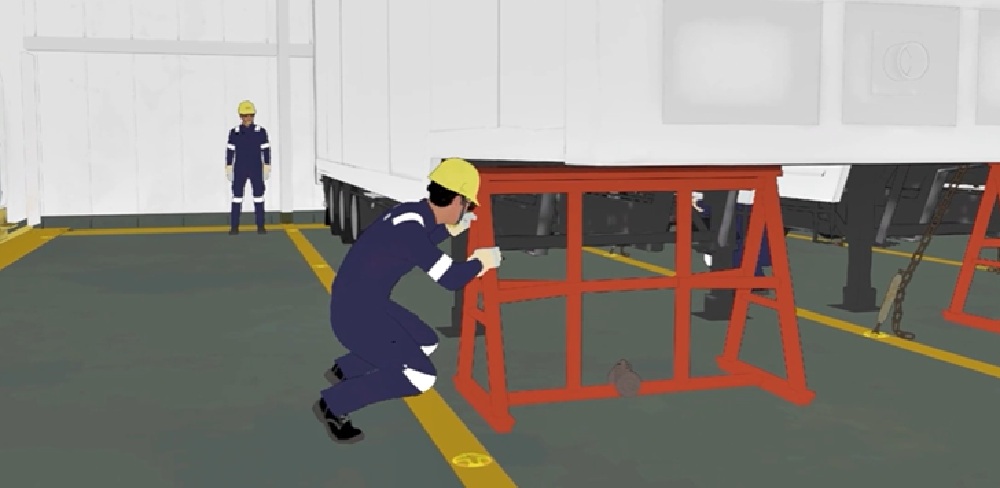
Despite established procedures and industry guidance, vehicle deck operations continue to result in serious injuries and fatalities, Akshat Arora, Regional Loss Prevention Director, Singapore, UK P&I Club, highlighted.
These incidents often occur during routine operations, such as loading and unloading, where the task is perceived as low-risk and familiarity can lead to complacency.
The case presented highlights how rapidly conditions on the vehicle deck can change, and how a momentary lapse in awareness or positioning can have irreversible consequences.
The incident:
A RoRo vessel was docked in port while the deck crew completed the final stage of loading on the upper vehicle deck. Shore tractor drivers were maneuvering heavy trailers into their designated stowage positions under the guidance of the ship’s crew. The bosun was acting as banksman, directing movements with hand signals and whistle blasts, assisted by two ordinary seamen responsible for positioning trestles and securing lashings.
Four trailers had already been safely parked and secured, leaving only one tight corner space bordered by a stiffening beam. As the final trailer slowly reversed into position, the bosun initially stood behind it on a painted walkway where he remained visible to the driver. However, after signaling, he moved away from the safe position, likely to check the trailer’s alignment, and unknowingly stepped into a narrow gap between the trailer’s rear corner and the stiffening beam.
This created a fatal pinch point with no room for escape once the trailer continued moving. The bosun was crushed between the trailer and the ship’s structure. Although a whistle blast sounded moments before impact, the driver remained unaware of the danger, disconnected the tractor unit, and drove away. Shortly afterward, one of the ordinary seamen discovered the bosun critically injured. Despite emergency efforts, he never regained consciousness.
The incident highlighted several critical failures. The bosun lost situational awareness by moving into an unsafe area behind the reversing trailer. The painted walkway created a false sense of security despite offering no physical protection from moving vehicles. Supervision was also insufficient, as no one maintained full oversight of the operation while the bosun was focused on marshalling. Communication broke down when the driver lost sight of the banksman but continued reversing regardless. In addition, the stiffening beam created an unmarked hazard that had not been adequately identified during risk assessment, while procedures for maneuvering trailers into confined corner spaces were either absent or inadequate.
Several important safety lessons emerged from the incident, closely aligned with the UK Chamber of Shipping’s 10 Golden Rules for Vehicle Deck Workers.
Safety is a shared responsibility, requiring clear communication and constant awareness of personnel positions during cargo operations. Crew members must remain visible at all times and avoid standing in front of, behind, or between moving vehicles. Drivers should stop operations immediately if visual contact with the banksman is lost.
The role of the banksman is also critical. Only one banksman should direct vehicle movements, and they must remain in a fixed, visible, and safe location until the maneuver is complete. Standardised hand and whistle signals should always be used consistently.
At its core, the incident reflects a breakdown in fundamental safety behaviours rather than a lack of procedures.
- Loss of situational awareness
- assumptions that conditions remained safe
- and lack of control over vehicle movements are recurring factors in such events.
This incident reinforces that vehicle deck safety relies on disciplined execution of simple, well-understood rules. Routine operations should never be treated as low risk. Every movement must be planned, clearly controlled, and continuously monitored, ensuring that personnel remain visible, aware, and clear of danger zones at all times.
The case raises broader questions for ship operators and crews:
- How are blind spots and pinch points identified and marked on vehicle decks?
- What procedures ensure drivers always know the banksman’s location?
- Who maintains overall supervision during high-risk cargo operations?
- And do documented procedures accurately reflect what happens in practice onboard?
Ultimately, what began as a routine loading operation turned fatal within seconds, underlining how quickly a lapse in visibility, communication, or positioning can lead to tragedy during vehicle deck operations.
Robban Assafina is now on WhatsApp channel. Click Here


