Union of Greek Shipowners (UGS) has released its Annual Report for 2025–2026, highlighting the continued global dominance of Greek shipping and the sector’s expanding role in international trade.
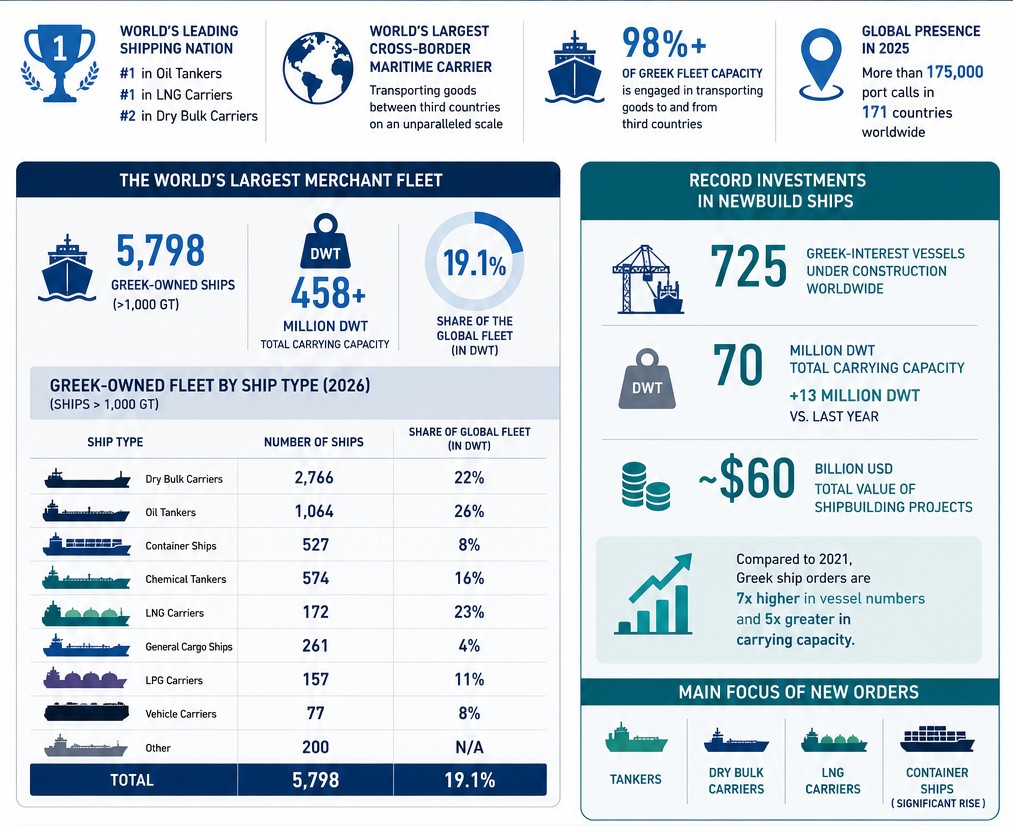
According to the report, Greece remains the world’s leading shipping nation, maintaining a commanding presence in key strategic vessel categories. Greek shipping continues to rank first globally in oil tankers and liquefied natural gas (LNG) carriers, while holding second place in dry bulk carriers.
The report also underscores Greece’s role as the world’s largest cross-border maritime carrier, transporting goods between third countries on an unparalleled scale.
Greek shipping drives global trade
Unlike many other major shipping powers, Greek shipping is overwhelmingly focused on serving international trade flows beyond Greece’s borders. More than 98% of the carrying capacity of the Greek-owned fleet is engaged in transporting goods to and from third countries, reinforcing its role as a backbone of global commerce rather than domestic trade.
The scale of Greek shipping activity in 2025 illustrates the industry’s extensive international footprint. Greek-owned vessels recorded more than 175,000 port calls across 171 countries worldwide during the year, demonstrating the sector’s vast operational reach and strategic importance to the global supply chain.
Greek shipping continues to operate primarily in the bulk and tramp shipping sectors.
Fleet expansion continues in 2025
The report highlights another year of robust growth for the Greek-owned merchant fleet. Greek shipping now accounts for 19.1% of the global fleet in terms of deadweight tonnage (dwt), consolidating its position as the largest merchant fleet in the world by carrying capacity.
The Greek-owned fleet currently consists of approximately 5,800 ships, with total carrying capacity exceeding 458 million dwt. These figures reinforce Greece’s longstanding maritime leadership and its central role in international seaborne trade.
Number of Greek-Owned ships and share of the global fleet (in dwt), 2026 (ships > 1,000 gt)
| Ship Type |
Number of Ships |
Share of Global Fleet |
| Dry Bulk Carriers |
2,766 |
22% |
| Oil Tankers |
1,064 |
26% |
| Container Ships |
527 |
8% |
| Chemical Tankers |
574 |
16% |
| Liquefied Natural Gas (LNG) Carriers |
172 |
23% |
| General Cargo Ships |
261 |
4% |
| Liquefied Petroleum Gas (LPG) Carriers |
157 |
11% |
| Vehicle Carriers |
77 |
8% |
| Other |
200 |
N/A |
| Total |
5,798 |
19.1% |
Shipping remains the most efficient form of transport
The annual report also emphasizes shipping’s status as the most energy-efficient and economical mode of mass transportation. Despite the continued growth of global maritime trade, the industry has made measurable progress in reducing its environmental footprint.
International shipping’s share of global greenhouse gas (GHG) emissions has remained stable at 1.4% for three consecutive years, a result presented in the report as evidence of the sector’s ongoing efficiency improvements and emissions-control efforts.
Within the European Union, shipping’s contribution to overall transport-sector emissions has also fallen significantly. The sector accounted for 15% of transport emissions in 1990, rising to 16.8% during 2007–2008 before declining sharply to a historic low of 13.3% in 2023.
The report attributes part of this progress to technological upgrades, operational efficiencies, and increasing investment in environmentally friendly vessel technologies.
Source: Union of Greek Shipowners (UGS) data / Image Credit: SAFETY4SEA
Record investments in newbuild ships
Greek shipowners have also intensified investments in fleet renewal and expansion. According to the report, 725 Greek-interest vessels are currently under construction worldwide, with a combined carrying capacity of 70 million dwt.
This represents an increase of 13 million dwt compared with the previous year. The total value of these shipbuilding projects is estimated at approximately 60 billion US dollars.
The scale of investment marks a dramatic increase compared with 2021. Greek ship orders are now seven times higher in terms of vessel numbers and five times greater in carrying capacity than they were just four years ago.
Greek investors continue to focus heavily on tankers, dry bulk carriers, and LNG carriers, sectors where Greece already holds substantial global market share. At the same time, the report notes a significant rise in orders for container ships, indicating broader diversification across shipping segments.
Environmental performance shows continued improvement
The Union of Greek Shipowners also highlighted steady progress in the environmental performance of the Greek fleet. Adoption rates of energy-saving technologies and efficiency-enhancing equipment are rising across all categories of ships.
One of the clearest indicators of this transition is the rapid increase in vessels equipped with energy-saving technologies. At the beginning of 2024, only one in three Greek-owned ships had installed at least one such system. Today, that figure has risen to more than 50% of the fleet.
The report presents this trend as evidence that Greek shipping is accelerating its transition toward greener operations while continuing to expand its global leadership in maritime transport.
A pillar of the global economy
The findings of the 2025–2026 annual report reinforce the strategic significance of Greek shipping not only for Greece but for the global economy as a whole. With nearly one-fifth of global carrying capacity under Greek ownership, continued multi-billion-dollar investments in modern vessels, and growing adoption of environmentally sustainable technologies, Greek shipping remains one of the most influential forces in international maritime trade.
As geopolitical uncertainty, energy security concerns, and global trade demands continue to reshape shipping markets, the Greek maritime industry appears poised to maintain its dominant position for years to come.
"Within this demanding environment, Greek shipping has maintained its leading international position, reaffirming its strategic importance, reliability, and resilience. The Greek-owned fleet continues to play a leading role in international maritime transport, contributing decisively to energy security, food supply sufficiency, and the stability of global supply chains "said Melina Travlos, President of UGS.
In an earlier statement referencing Posidonia, the major event for Greek shipping, Melina Travlos noted that it brings together the global maritime community and underscores the strategic importance of an industry that not only transports goods and energy but also underpins the very functioning of the modern world.
Source : Safety4sea
Robban Assafina is now on WhatsApp channel. Click Here