
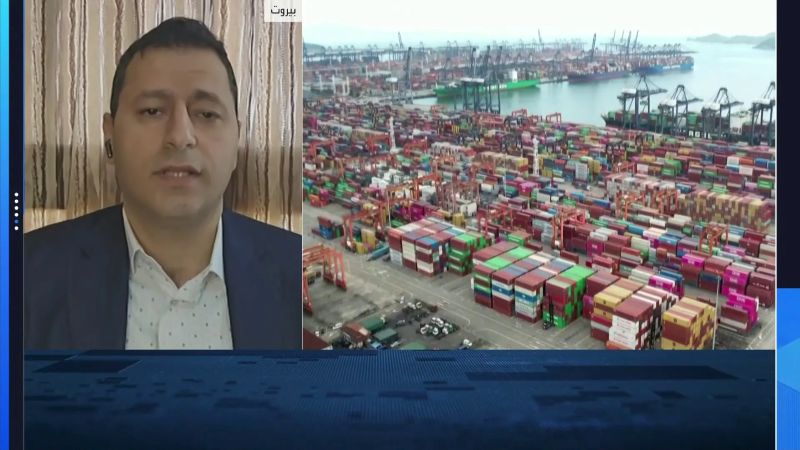
The repercussions of the disruption to shipping in the Strait of Hormuz continue to affect global trade, with major shipping companies warning of severe bottlenecks and an unprecedented rise in transportation costs, as a result of the increased reliance on alternative land routes following the near-closure of the strait since the outbreak of the war with Iran.
Shipping rates on the Shanghai-Gulf and Red Sea route have risen to record levels, with the cost of transporting a standard container jumping from about $980 before the crisis to more than $4,100 in mid-May, exceeding the highest levels recorded during the coronavirus pandemic.
Major global shipping companies, including MSC, Maersk, CMA-CGM and Hapag-Lloyd, are trying to alleviate the pressure by creating land bridges to transport goods by truck from Red Sea and Gulf of Oman ports to Arabian Gulf ports, passing through Saudi Arabia, Iraq and the UAE
Haytham Chaaban, a consultant and auditor accredited by the International Maritime Organization and publisher of the magazine and website "Robban Assafina" (Ship Captain), confirmed that the maritime shipping sector is currently facing a maritime logistics emergency as a result of escalating geopolitical tensions in the region, noting that the picture remains unclear with the continuation of the war between the United States and Iran and the increasing instability.
Shaaban explained in an interview with Al Arabiya Business that the current crisis has directly impacted global shipping companies, especially with the return of Somali pirate activity and the recent kidnapping of ships, including ships owned by Syrians.
He pointed out that maritime shipping costs have already exceeded the levels recorded during the coronavirus pandemic, and predicted that the rise would continue if oil prices increased, given that marine fuel represents one of the largest components of ships' operating costs.
High demand for truck fleets
He said that land transport prices have also increased, after the crisis boosted demand for trucks to transport containers between the Red Sea and the Arabian Gulf, putting pressure on transport fleets and prompting some countries to resort to trucks from neighboring countries, in addition to Turkish companies entering the market to take advantage of the increased demand.
He added that the cost of transporting goods using multiple means of transport has increased to about three times compared to normal levels, especially for shipments coming from China to the Gulf countries via ports such as Jeddah or Omani ports, in addition to a noticeable increase in shipping and delivery time.
Shaaban stressed that land transport cannot compensate for the absence of the giant ships that used to cross the Strait of Hormuz, explaining that the largest container ship, which can accommodate 24,000 containers, theoretically needs 24,000 trucks to transport its entire cargo, reflecting the size of the current logistical gap.
He also pointed out that the disruptions are not limited to container ships only, but extend to general cargo ships, car carriers, bulk carriers and other maritime sectors, in addition to the continued suffering of a number of ships stuck inside the Arabian Gulf.
Operational problems facing ships stranded in the Gulf
He also pointed to the emergence of new operational and environmental problems, including the accumulation of waste on board ships as a result of their inability to dock in the usual ports, explaining that ships are floating cities that constantly need waste disposal services and logistical supplies.
Shaban warned that the most dangerous scenario would be the continued closure of the Strait of Hormuz for a longer period, coinciding with rising oil prices and the imposition of new transit fees, which could lead to a redrawing of the global maritime trade map and extend the impact to other strategic passages such as the Strait of Gibraltar.
The decline in ship traffic through the Strait of Hormuz has led to a decrease in trade flows to the Gulf region by up to 86%, according to estimates by global shipping companies.
Robban Assafina is now on WhatsApp channel. Click Here


