
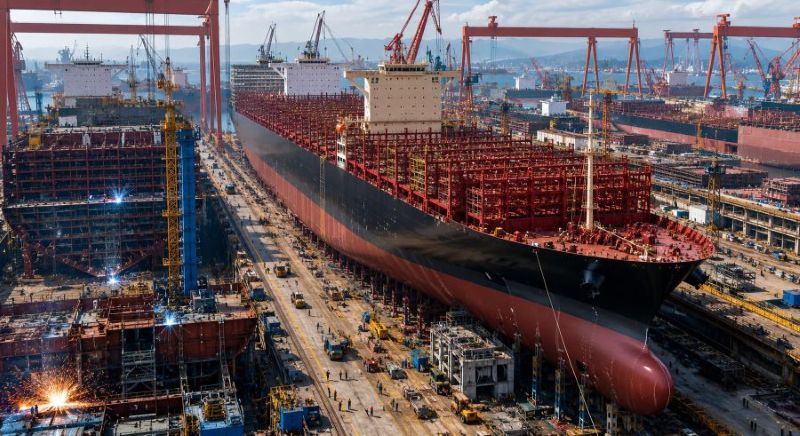
China received more than 60% of global ship orders in 2025, delivered 56% of world production, and expanded dominance over South Korea, Japan, Europe, and the USA.
According to Maritime Executive, of the approximately 2,500 ships ordered worldwide in 2025, more than 1,500 went to China shipyards, a volume exceeding 60% of the global total. In tonnage, the Chinese share was even greater: about 62%, according to Clarksons, and 69%, according to the Ministry of Industry and Information Technology of China.
China also delivered 53.7 million DWT in 2025, equivalent to 56% of all global shipbuilding production for the year. South Korea, in second place, signed contracts for 260 ships, just over 10% of the world total. Japan, which led the sector for decades, lost market share for five consecutive years.The three largest European shipyards, Fincantieri, Meyer, and Chantiers de l’Atlantique, do not even appear among the top 30 in the world by volume. Meanwhile, American shipyards, although maintaining the largest military naval fleet on the planet, have not competitively built large commercial ships for more than four decades.
China dominates global shipbuilding with more than 60% of ship orders in 2025
Chinese shipbuilding has ceased to be just a story of industrial expansion and has come to represent a profound shift in the control of the global maritime chain. In 2025, most of the new ships ordered worldwide were contracted at Chinese shipyards.This dominance is evident both in the number of vessels and in the tonnage contracted. In practice, this means that China is not only producing many small ships but is also concentrating orders for large vessels, such as bulk carriers, tankers, container ships, and industrial ships.
According to a study cited by the Cheung Kong Graduate School of Business, in 2024 the largest Chinese state-owned shipyard built more commercial ships by tonnage than the entire American shipbuilding industry since the end of World War II. This is not rhetorical exaggeration: it is the real dimension of the industrial gap opened between China and the United States.
Robban Assafina is now on WhatsApp channel. Click Here


