
Lloyd’s Register has released its updated Fuel for thought: LNG report, highlighting LNG as a mature and increasingly central “fuel in transition” for the maritime sector.
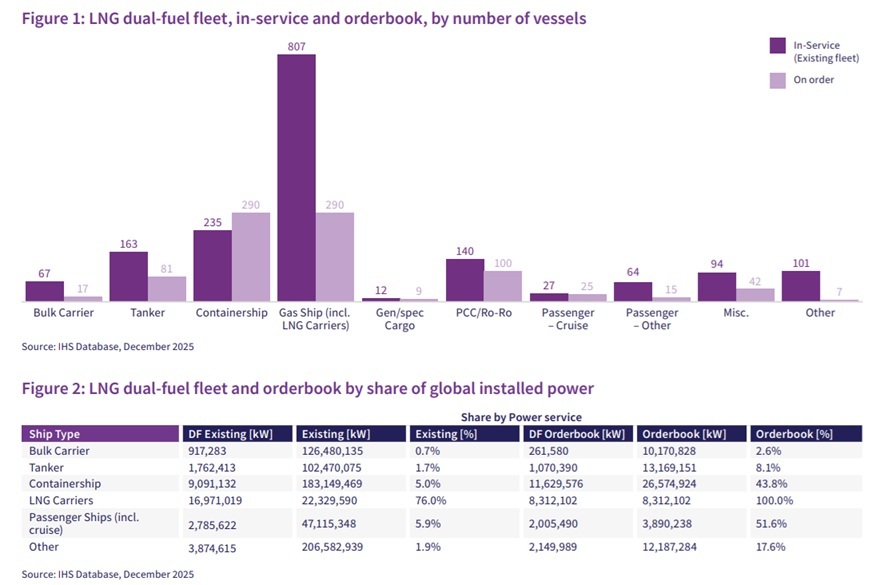
As of March 2026, the global dual-fuel LNG fleet has reached 1,665 vessels, with 982 more on order, reinforcing LNG’s position as the leading alternative fuel in current shipbuilding pipelines. While uncertainty around other alternative fuels has affected investment decisions, LNG continues to dominate due to its readiness and scalability.
Growth is particularly strong in the container segment, which is expected to more than double its LNG-capable fleet. Other sectors, including cruise, tanker, and PCC/RoRo, are also accelerating adoption, signalling broad industry confidence in LNG as a near- to mid-term solution.
"The findings in our new report underline that this continued interest in LNG is not solely a bridge to other fuels, but a strategic response to tightening global and regional regulation. We need to intensify our focus on methane emissions, clean LNG variants and improving the LNG value chain GHG footprint"
… commented Panos Mitrou, SVP Shipping Strategy, Lloyd’s Register.
Economic viability and regulatory outlook
According to LR’s modelling, LNG remains the most cost-effective alternative fuel pathway through to 2050 across all major regulatory scenarios assessed. Its competitiveness could further improve through blending with bio-LNG and e-LNG, enabling vessels to generate compliance surpluses in the early phases of emerging regulations.
The report emphasizes that LNG is not merely a transitional bridge but a strategic response to tightening global and regional emissions rules. However, it also notes that current regulatory frameworks do not fully reflect recent technological advances, particularly in emissions performance.
Methane emissions and technology progress
A key focus of the report is the significant reduction in methane slip. High-pressure two-stroke engines now achieve levels as low as 0.2 g/kWh, while low-pressure engines equipped with exhaust gas recirculation have reduced emissions by over 60%.
Despite these gains, existing emissions factors under frameworks such as FuelEU Maritime and IMO lifecycle guidelines have yet to be updated.
LR argues that revising these factors is critical to accurately reflect real-world performance and to avoid penalizing early adopters of cleaner LNG technologies. Addressing methane emissions remains central to improving LNG’s overall environmental profile.
Supply chain and operational considerations
The report also highlights the importance of upstream emissions, stressing that cleaner LNG production, reduced methane leakage, and robust certification schemes are essential to achieving full lifecycle emissions reductions. As renewable gas supply chains develop, verified certification will play a key role in ensuring transparency and credibility.
In addition, operational aspects such as drydocking procedures for LNG-fuelled vessels are examined, with recommendations aimed at improving planning, safety, and execution.
Overall, LNG is expected to remain a core component of shipping’s energy transition as infrastructure expands and emissions technologies continue to evolve.
"As global bunkering infrastructure continues to expand, renewable gas supply chains mature, and emissions control technologies become more widely adopted, LNG is expected to remain a central component of the maritime sector’s transitional energy landscape"
… said Constantinos Chaelis, Global Gas Segment Director, Lloyd’s Register.
Robban Assafina is now on WhatsApp channel. Click Here

.jpg&w=256&q=75)


