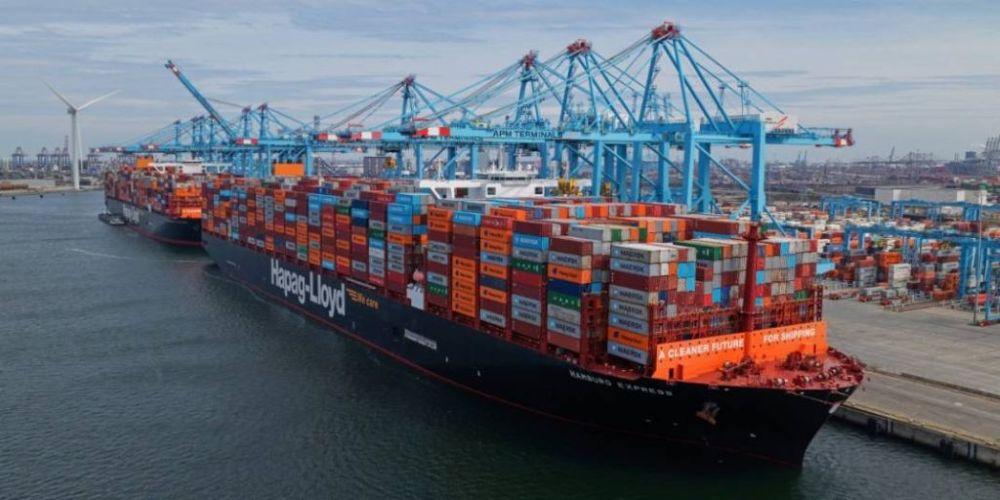
Rolf Habben Jansen expects the record container ship order book to leave the market with too many ships in 2028 and 2029, though nothing like the glut that followed 2009. The Hapag-Lloyd chief executive says slower sailing, scrapping and stronger trade will absorb much of it, and that LNG remains the fuel most owners are choosing for newbuilds.
The container ship order book now stands at about 45% of the existing fleet, or at least 15 million TEU, up from 40% at the end of August. Maritime journalist Janet Porter put those figures to Rolf Habben Jansen, CEO of Hapag-Lloyd, in the fifth episode of the carrier’s Straight Talk podcast. She asked him whether the industry was showing sound business sense or collective madness.
His reply was measured: Hapag-Lloyd has a fair number of ships on order itself, he admitted, and he accepts that a surplus will arrive at some stage “because this is a cyclical industry and that has not changed, contrary to maybe what some people think”.
Surplus expected in 2028, not 2027
By his count, deliveries will add about 8% to capacity next year, about 12% in 2028 and around 9% the year after. Volumes on the dominant legs have grown by roughly 25% in three years, and he expects another 5% or slightly more next year. “I don’t see a big risk for overcapacity in 27,” he said. He is far less sure about 2028, when he rates the chance of demand fully absorbing the new tonnage at under 50%.
On who is buying, he said it is mainly the liner companies, with non-operating owners ordering against charter commitments. Speculative contracts remain rare. Hapag-Lloyd plans to add capacity at 4% to 6% a year, and he was blunt about some rivals: “for some people the money seems to be burning in their pockets”.
Slower sailing and scrapping to absorb tonnage
Owners do have tools to manage a surplus. “Today, we sail faster than we actually should,” Habben Jansen said, explaining that congestion forces ships to make up lost time. With enough tonnage available, most services would run one to one and a half knots slower at current fuel prices, which means adding one vessel to a typical Asia-Europe loop.
Scrapping is the second tool. Demolition has averaged half a per cent of the global fleet over the past ten years. “If it would stay like that, it would mean that you need every ship for 200 years,” he said. He expects it to climb back to 4% or 4.5% a year, with close to 4 million TEU of capacity older than 25 years by 2030. If rates fall below variable costs, lay-ups will follow.
LNG leads the fuel choice, retrofits prove costly
The fuel decision is where his remarks will interest technical and ship management teams most. “I guess today, most people bet on LNG, which could be also e-methane or bio-LNG if you want to be completely green,” he said. Hapag-Lloyd is also building methanol ships. He is sceptical about ammonia because of its toxicity, and he sees nuclear as a real option for larger ships from around 2040, though only on new tonnage.
His warning on conversions was drawn from experience. Recalling the company’s first LNG retrofit, he said: “We thought that it would cost 25 million and would take 60 days. I think in the end it cost 43 million and it took 125 days.” Methanol retrofits now under way are staying within budget, he added, and cost much less.
The lesson for owners and managers is that the fuel chosen at the yard is hard to undo later, so the specification deserves more attention than the delivery slot. Habben Jansen said as much about waiting for berths: “whether they come six months earlier or later, it really doesn’t matter all that much.”
He expects a little more ordering in the coming months but does not think the order book will be materially bigger a year from now. Fleet planners should be watching 2028, when slow steaming and the retirement of older ships will have to do the work that demand growth has done so far.
Robban Assafina is now on WhatsApp channel. Click Here