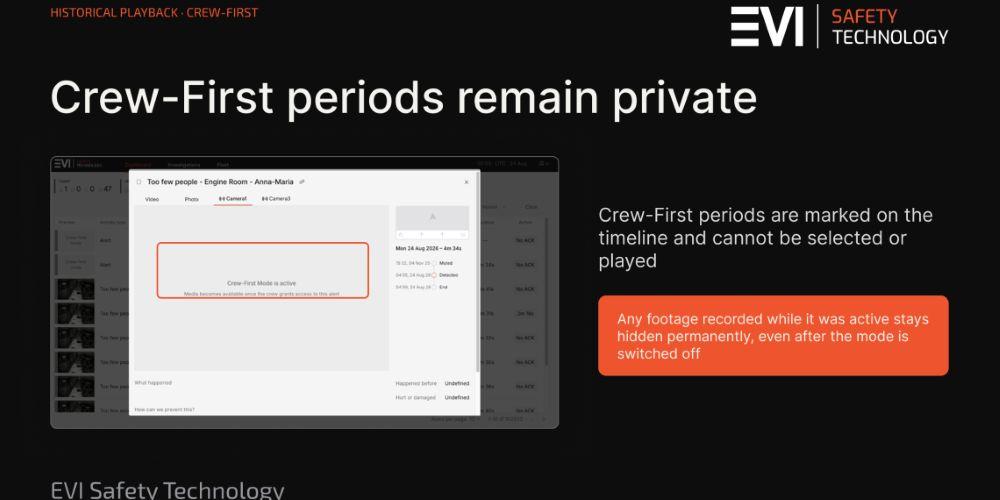
EVI Safety Technology has launched Crew-First Mode, a setting that allows shipboard AI cameras to raise safety alerts while keeping alert footage onboard and disabling routine viewing from shore. The system gives ship managers a way to use automated risk detection while placing tighter limits on access to crew images.
EVI Safety Technology has introduced a new setting for its onboard AI camera system that allows safety alerts to reach shore teams without giving them routine access to the associated footage.
Crew-First Mode keeps alert media onboard and disables routine shore viewing when the setting is activated. The system uses existing cameras to recognise risks and alert crew members, allowing them to respond while limiting the circulation of recorded images.
The launch addresses an operational concern for shipowners and managers adopting camera-based safety systems. While automated detection can help crews identify hazards, unrestricted access to footage may create concerns about privacy and workplace monitoring, particularly aboard vessels where crew members live as well as work.
Vladimir Ponomarev, CEO of EVI Safety Technology, said: “I’ve been a seafarer. I know what it feels like to work under pressure, far from home, with your decisions carrying real consequences.”He added: “If we put cameras around a crew, we owe them more than a promise that the footage will be used responsibly. We have to build those limits into the system.”
EVI cited two US workplace surveys in its announcement. A 2024 survey found that 68% of US workers reported at least one form of electronic monitoring at work, while separate Pew Research Center research found that 81% of US adults believed workers would probably or definitely feel inappropriately watched if employers used AI to monitor and evaluate them. These figures concern US workplaces generally and are not specific to maritime workers.
The consideration is how to balance safety monitoring with crew trust. Restricting routine access to footage may help establish clearer boundaries.
The system also raises a wider management issue. AI safety tools must be judged by their ability to identify hazards and support timely action, alongside the safeguards governing recorded data. EVI’s approach gives operators a framework for limiting surveillance, but its effectiveness will depend on implementation and the procedures governing access to footage.
Robban Assafina is now on WhatsApp channel. Click Here