
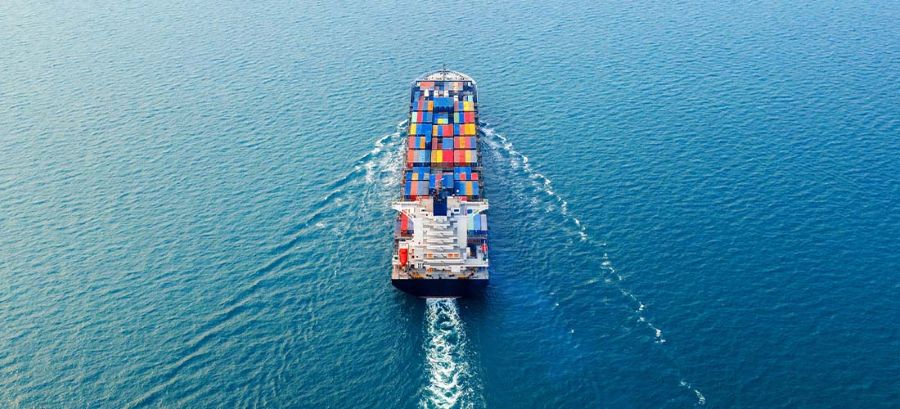
China's first fully electric smart container ship, and the world's largest of its kind, officially commenced commercial operation on the afternoon of April 15th, marking a new step forward in the development of green shipping and electrification along the country's coast.
The ship "Ning Yuan Dian Kun" departed from Ningbo-Zhushan port to Jiaxing port in Zhejiang province, on a route traditionally used by fossil fuel-powered ships, but now undergoing a strong shift towards electrification.
Developed independently by the Shanghai Institute of Commercial Ship Design and Research, the vessel is equipped with a fully electric propulsion system, offering intelligent and highly efficient operation, zero carbon emissions, no noise, and no pollution.
The ship is 127.8m long, 21.6m wide, has a design draft of 6.2m, and a capacity of 742 TEU (equivalent to 742 20-foot containers).
The ship uses 10 containerized batteries with a total capacity of 20,000 kWh, and two 875 kW permanent magnet synchronous motors, expected to reduce CO₂ emissions by 1,462 tons per year.
In terms of intelligent features, the vessel is equipped with intelligent navigation and motor systems, enabling automatic collision avoidance, precise tracking, and integrated ship-shore-cloud control.
The dual charging system combines high-voltage shore power and fast battery swapping to provide flexible and efficient energy charging.
The open deck design improves cargo handling efficiency, while the bow reduces wind resistance by 15-20%, enhancing operational performance.
The word "Kun" in the ship's name is inspired by "Zhuangzi," referring to a giant fish in ancient Chinese literature. The sister ship, "Ning Yuan Dian Peng" (with "Peng" meaning giant bird), is scheduled for sea trials in May and delivery in June.
It is expected that the two ships, once operational, will form a large-scale, green shipping route on fixed lines.
Chen Xiaofeng, Chairman of Ningbo Shipping Company, the operator, said: “This project demonstrates our commitment to the green transformation of the shipping industry and contributes to China’s dual carbon goals.”
Robban Assafina is now on WhatsApp channel. Click Here


