
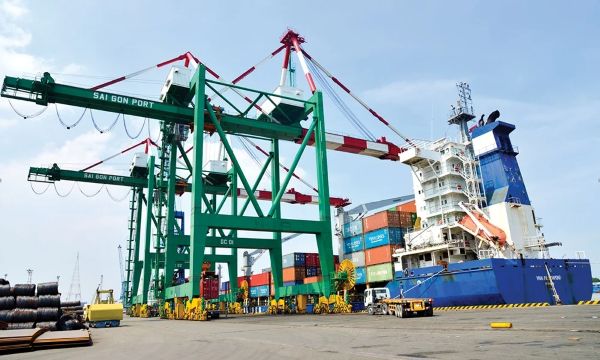
In the context of Resolution 36-NQ/TW on sustainable development of the marine economy until 2030, with a vision to 2045, aiming to make Vietnam a strong maritime nation, Saigon Port Joint Stock Company (Saigon Port) faces both the opportunity and the responsibility to become one of the important maritime and logistics connection points in the region.
Following the guidelines of the Vietnam Maritime Corporation ( VIMC ) and the decisive direction of the Party Committee, Board of Directors, and Executive Board, in 2025, Saigon Port accelerated organizational restructuring and put the Humax HR system into operation to modernize human resource management. Building on the achievements, Saigon Port enters 2026 with the orientation of continuing in-depth restructuring, taking human resources and technology as the two pillars throughout management and operation. At the same time, the unit focuses on optimizing existing infrastructure and strengthening linkages, ensuring synchronization between member units and joint ventures and affiliated companies.
The Cai Mep – Thi Vai port cluster is also identified as a strategic national seaport center, capable of handling multiple mother vessel routes with carrying capacities ranging from 10,000 to 24,000 TEU, playing a key role as a gateway directly connecting Vietnam with international shipping routes. Saigon Port, together with VIMC, is collaborating with leading global partners such as SSA Marine (USA), APM Terminals (Denmark), and Singapore PSA Vietnam to develop deep-water ports in the Cai Mep – Thi Vai cluster, including SSIT, CMIT, and SP-PSA. These ports are currently operating effectively and playing a connecting role, laying the groundwork for the formation and development of an international transshipment center in the Cai Mep – Thi Vai and Can Gio areas in the future.
Based on that experience, Saigon Port has identified the Can Gio International Transshipment Port project as a strategic development direction and will focus its investment resources on it in the coming time. Currently, the project is in the investor selection phase. Once operational, the Can Gio International Transshipment Port is expected to enhance logistics capacity, attract investment, and increase the international maritime standing of Ho Chi Minh City and Vietnam.
According to the plan, Can Gio International Transshipment Port will implement a comprehensive set of solutions to reduce emissions, such as equipping with electrified equipment (e-RTG, e-AGV, e-Forklift…), prioritizing vehicles using clean fuels, strengthening energy management, and promoting automation in operations. This approach is also in line with international trends, meeting the Net Zero target by 2050 and creating a foundation for Can Gio Transshipment Port to become Vietnam's first green port.
Furthermore, Saigon Port is proactively preparing for the rearrangement of land use and the conversion of operational functions in the Nha Rong, Khanh Hoi, and Tan Thuan areas.
This conversion is closely linked to the progress of the Nguyen Tat Thanh road upgrade and expansion project and the Thu Thiem 4 bridge construction project, opening up opportunities for Saigon Port to shape new operational models suitable for the modern and sustainable development trends of a future urban port.
With a clear strategic direction and a strong spirit of innovation, Saigon Port is asserting its pivotal role in implementing the objectives of Resolution 36-NQ/TW, thereby contributing to enhancing the position of Vietnamese seaports in the region and internationally.
Saigon Port has identified 2026 as a key period for comprehensively completing solutions in governance, operation, and investment. The focus will be on further streamlining the operational model, strengthening inter-unit coordination, removing infrastructure and land bottlenecks, and promoting technology application, improving personnel quality, and enhancing asset utilization efficiency. With clear direction and specific solutions, Saigon Port expects to create a solid foundation to achieve its 2026 plan targets, aiming for stable and sustainable development.
Following the guidelines of the Vietnam Maritime Corporation ( VIMC ) and the decisive direction of the Party Committee, Board of Directors, and Executive Board, in 2025, Saigon Port accelerated organizational restructuring and put the Humax HR system into operation to modernize human resource management. Building on the achievements, Saigon Port enters 2026 with the orientation of continuing in-depth restructuring, taking human resources and technology as the two pillars throughout management and operation. At the same time, the unit focuses on optimizing existing infrastructure and strengthening linkages, ensuring synchronization between member units and joint ventures and affiliated companies.
The Cai Mep – Thi Vai port cluster is also identified as a strategic national seaport center, capable of handling multiple mother vessel routes with carrying capacities ranging from 10,000 to 24,000 TEU, playing a key role as a gateway directly connecting Vietnam with international shipping routes. Saigon Port, together with VIMC, is collaborating with leading global partners such as SSA Marine (USA), APM Terminals (Denmark), and Singapore PSA Vietnam to develop deep-water ports in the Cai Mep – Thi Vai cluster, including SSIT, CMIT, and SP-PSA.
These ports are currently operating effectively and playing a connecting role, laying the groundwork for the formation and development of an international transshipment center in the Cai Mep – Thi Vai and Can Gio areas in the future.
Based on that experience, Saigon Port has identified the Can Gio International Transshipment Port project as a strategic development direction and will focus its investment resources on it in the coming time. Currently, the project is in the investor selection phase. Once operational, the Can Gio International Transshipment Port is expected to enhance logistics capacity, attract investment, and increase the international maritime standing of Ho Chi Minh City and Vietnam.
According to the plan, Can Gio International Transshipment Port will implement a comprehensive set of solutions to reduce emissions, such as equipping with electrified equipment (e-RTG, e-AGV, e-Forklift…), prioritizing vehicles using clean fuels, strengthening energy management, and promoting automation in operations. This approach is also in line with international trends, meeting the Net Zero target by 2050 and creating a foundation for Can Gio Transshipment Port to become Vietnam's first green port.
Furthermore, Saigon Port is proactively preparing for the rearrangement of land use and the conversion of operational functions in the Nha Rong, Khanh Hoi, and Tan Thuan areas. This conversion is closely linked to the progress of the Nguyen Tat Thanh road upgrade and expansion project and the Thu Thiem 4 bridge construction project, opening up opportunities for Saigon Port to shape new operational models suitable for the modern and sustainable development trends of a future urban port.
With a clear strategic direction and a strong spirit of innovation, Saigon Port is asserting its pivotal role in implementing the objectives of Resolution 36-NQ/TW, thereby contributing to enhancing the position of Vietnamese seaports in the region and internationally.
Saigon Port has identified 2026 as a key period for comprehensively completing solutions in governance, operation, and investment. The focus will be on further streamlining the operational model, strengthening inter-unit coordination, removing infrastructure and land bottlenecks, and promoting technology application, improving personnel quality, and enhancing asset utilization efficiency. With clear direction and specific solutions, Saigon Port expects to create a solid foundation to achieve its 2026 plan targets, aiming for stable and sustainable development.


