
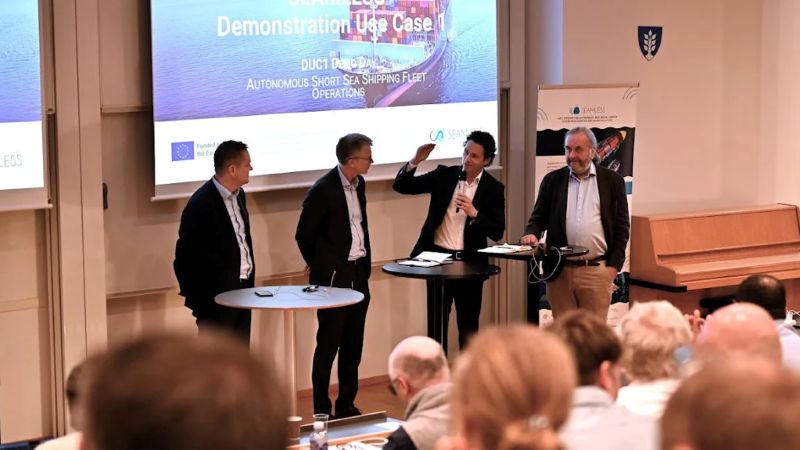
MacGregor has demonstrated its latest smart maritime innovations at the first official demonstration day of the EU-funded SEAMLESS project, showcasing the transition of advanced digital solutions from concept development to real-world validation.
Held on 3 June 2026 at the University of South-Eastern Norway in Horten, the event marked a major milestone for the project, which brings together 26 companies, research institutes, and universities from 12 EU countries to develop more efficient, automated, and resilient solutions for short-sea and inland shipping.
A Stepping Stone to Modern Logistics
MacGregor's role in SEAMLESS is the direct continuation of its long-term automation roadmap. The current technology builds upon successful foundations laid during earlier EU-funded projects, MOSES and AEGIS. While those initial projects proved that automated systems could successfully transfer cargo from a quayside, the SEAMLESS project focuses on making these systems smarter, allowing them to handle complex real-life routes and commercial shipping environments.
MacGregor CEO Jonas Gustavsson delivered a prominent keynote address at the Horten event, reinforcing the company's commitment to driving automated logistics: "Today, we have seen the future. We now have proof of concept that these integrated digital and physical systems work seamlessly in real-world scenarios. Our focus must now turn to collaborative efforts on international regulations and safety frameworks to maintain this momentum across the European maritime ecosystem."
MacGregor's Core Innovations
The June demonstration focused on a real-world route in Norway's Oslo Fjord, where autonomous "sea drones" transport trailers and containers between ports. Within this operating environment, MacGregor showcased two core innovations designed to streamline port operations and cargo planning:
1. Voyage and Container Optimisation Platform (VCOP)
VCOP is a web-based software application that connects automated port equipment directly with live supply chain data.
Smart Cargo Planning: The software automatically takes cargo bookings from shippers and instantly generates safe, optimized loading and stowage plans for the vessel, taking into account the route and multiple upcoming port stops.
Real-Time Tracking: Integrated into a Remote Operation Center, VCOP allows operators to monitor the exact location and loading status of individual cargo units as they are handled.
Reliability and Predictability: Rather than focusing purely on speed, VCOP drives reliability. If a container is a "no-show" or arrives late, the platform can recalculate and update the loading plan in seconds, significantly reducing the mental burden on planners and keeping the ship on schedule.
2. The Autonomous Triple Joint Crane Concept
This next-generation robotic crane design is tailored for highly precise, automated container handling where traditional wire-controlled cranes run into limitations.
- High Precision: Operating with robotic joint movements, the crane keeps a rigid grip on cargo to guide containers directly and safely into a vessel's cargo guides.
- Movement Compensation: The crane's advanced winches eliminate load swing and dynamically tilt the container to adjust for the ship's natural movement and tilting in the water during loading.
- Smart Safety Sensors: The crane utilizes a network of cameras and advanced sensors to accurately locate targets and monitor the surrounding area, automatically pausing operations if an unexpected obstacle or person enters the safety zone.
Note: The triple joint crane's capabilities have been fully validated within advanced digital simulation environments by MacGregor's R&D team, proving the technical readiness of high-precision autonomous cargo handling.
Multiport Central European Deployment in October 2026
MacGregor is already preparing for the second SEAMLESS demonstration scheduled for 21 October 2026, which will take the technology into the busy environment of European inland waterways.
The upcoming demonstration event will be hosted at the Port of Antwerp-Bruges. Among other SEAMLESS innovations, it will feature the live testing of an Autonomous Mooring System utilizing a robotic mooring arm mounted onboard the inland vessel LETITIA. This system builds on the pioneering automated mooring technology MacGregor originally developed for the famous autonomous vessel Yara Birkeland, using smart robotics to secure the ship to port bollards automatically.
Highlighting the critical nature of this next step, Hugo Rosano, Technical Lead, emphasizes why transitioning from simulations to physical testing is vital for the success of the project:
"Simulations give us a fantastic foundation, but live, real-world testing is essential. It is the only way to catch real-world commissioning and operational challenges that only show up when you are out on open water. Furthermore, the development framework within SEAMLESS has actively helped us enhance our existing products in ways that simply wouldn't have been possible otherwise."
Concurrently, MacGregor’s VCOP will step into a defining role, managing automated, real-time cargo plans dynamically across a continuous ten-stop European port network: Duisburg – Gorinchem – Alblasserdam – Rotterdam – Moerdijk – Port of Antwerp-Bruges – Ghent – PoAB – Lille – Ghent.
Robban Assafina is now on WhatsApp channel. Click Here


