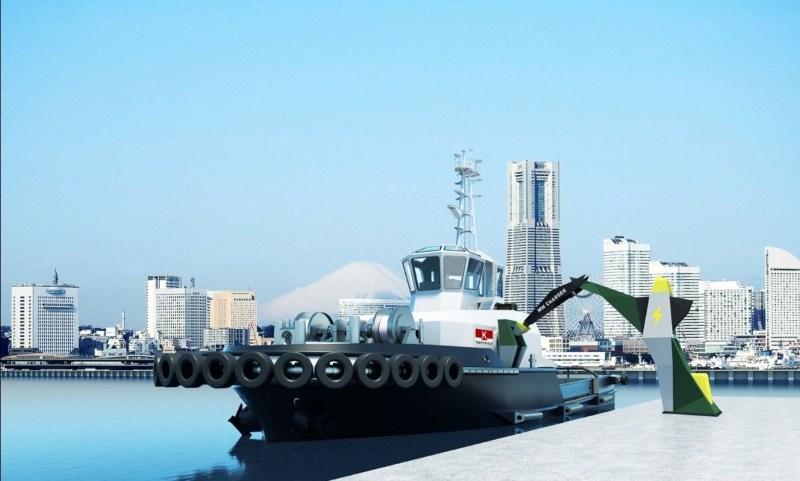
Tokyo Kisen Co., Ltd. (Head Office: Yokohama; President & CEO: Hiroyuki Saito, hereinafter “Tokyo Kisen”) and Marindows Inc. (Head Office: Tokyo; CEO: Yasumasa Suetsugu, hereinafter “Marindows”) have officially launched Japan’s first pure battery -powered EV harbor tugboat development project.
This EV harbor tugboat which will be operated in the ports of Yokohama and Kawasaki is aiming to contribute to “zero GHG emissions from the ports” in accordance with the Carbon Neutral Port (CNP) policy.
In January 2023, Tokyo Kisen put into service “TAIGA” which was the Japan’s first series-hybrid electric-powered tugboat equipped with a large-capacity 2,486 kWh battery. Building on two and a half years of operating experience with electric-powered tugs, this project advances to the next stage—enabling truly zero-emission (zero CO₂) operations—by developing and constructing a pure battery-powered EV tugboat. This could be possible by the combination of a large-capacity onboard battery system (6.66 MWh) and MW-class fast chargers.
Project and Vessel Overview
|
Project Owner |
Tokyo Kisen Co., Ltd. |
|
Project Coordinator |
Marindows Inc. |
|
Technical Support |
e5 Lab Inc. |
|
Vessel Type |
Harbor tugboat |
|
Propulsion Source |
Pure battery powered |
|
Scheduled Completion |
2030 (planned) |
|
Planned Operating Area |
Port of Yokohama and Kawasaki |
|
Principal Particulars |
Speed : 14.0 kn (approx. 26 km/h) |
Planned Schedule
2025: Detailed feasibility study and concept design.
(Final construction decision will be made based on the results of the detailed FS including the concept design.)
2026: Basic design (vessel, key equipment/systems, fast chargers).
2027: Detailed design (vessel, key equipment/systems, fast chargers).
2028: Construction starts of the vessel and fast-charging pier works.
2030: Commercial service starts at the ports of Yokohama and Kawasaki.