Low-cost compliance options under FuelEU Maritime could weaken incentives for shipping companies to invest in alternative fuels and decarbonization technologies, according to Korean Register (KR).
In its October 2026 Decarbonization Magazine, KR examines the outcomes of FuelEU Maritime’s first compliance cycle, highlighting the widespread use of pooling arrangements and declining prices for compliance surpluses.
The analysis, authored by JinHyung Kim, General Manager of KR’s Green Ship Technology Team, warns that shipowners should not base their long-term decarbonization strategies on the relatively inexpensive compliance options currently available.While pooling provides flexibility and reduces immediate compliance costs, KR emphasizes that meeting regulatory requirements does not necessarily translate into substantial emissions reductions.
Pooling dominates first FuelEU compliance cycle
FuelEU Maritime entered into application on January 1, 2025, requiring ships of 5,000 gross tonnage (GT) and above calling at EU ports to progressively reduce the well-to-wake greenhouse gas (GHG) intensity of the energy used onboard.
The regulation allows shipping companies to manage compliance through several mechanisms, including pooling surplus balances between vessels, banking surpluses for future use and borrowing against future compliance balances.
According to European Commission figures cited by KR, the first compliance cycle showed a strong preference for market-based flexibility mechanisms:
- 92% of regulated vessels used pooling arrangements to meet compliance requirements.
- 3% achieved direct compliance through lower-carbon fuels or technologies.
- 3% resolved their compliance deficits by paying regulatory penalties.
- 2% used borrowing arrangements against future compliance balances.
KR explains that the widespread use of pooling reflects its economic advantages during the initial phase of FuelEU Maritime, particularly given the availability of surplus compliance balances.
However, the findings also highlight a distinction between regulatory compliance and direct emissions reductions. Pooling allows vessels with compliance deficits to meet their obligations using surpluses generated by other ships, without necessarily requiring each participating vessel to adopt cleaner fuels.
Falling surplus prices favor short-term compliance
KR identifies a significant decline in FuelEU Maritime surplus prices during the first compliance cycle, based on data from OceanScore and BetterSea between May and July 2026.
According to the analysis, the decline was driven by several factors, including the relatively modest initial GHG intensity reduction target of 2%, an oversupply of compliance surpluses and reduced buying pressure following the first compliance deadlines.KR also notes that higher conventional fuel prices have narrowed the price difference between fossil fuels and biofuel blends, influencing the relative economics of alternative compliance strategies.
To evaluate these options, KR compared three approaches:
- VLSFO with pooling: Continuing to use very low sulfur fuel oil while purchasing surplus compliance balances.
- B30 biofuel: Using a blend containing 30% biofuel to achieve direct emissions reductions.
- VLSFO with penalties: Continuing to use conventional fuel while paying the applicable regulatory penalty.
Under the assumptions used in KR’s analysis, VLSFO combined with pooling was the most cost-effective option, followed by B30 biofuel, while paying penalties was the least economical.
The assessment considered both FuelEU Maritime compliance costs and EU Emissions Trading System (EU ETS) allowance costs.
These findings demonstrate why purchasing compliance surpluses may currently be more financially attractive than switching to lower-emission fuels. However, KR notes that the results depend on fuel prices, emissions factors, allowance costs and surplus prices.
Stricter targets could change the economics of compliance
Despite the current advantages of pooling, KR warns that low surplus prices and favorable compliance conditions are unlikely to continue indefinitely.
The FuelEU Maritime GHG intensity reduction target will increase from 2% to 6% in 2030, followed by further increases to 14.5% in 2035 and 80% by 2050.
According to KR, the tightening requirements are expected to reduce the availability of compliance surpluses, potentially shifting the market from oversupply toward deficits.
As surplus availability declines, KR anticipates that pooling prices could rise significantly, approaching the cost of regulatory penalties.
This would increase the financial burden on companies continuing to rely on conventional fuels and could strengthen the economic case for investing in alternative fuels and energy-saving technologies.
KR therefore cautions shipping companies against assuming that the low-cost compliance conditions experienced during the first cycle will remain available as regulatory requirements become more demanding.
Shipowners urged to look beyond immediate compliance costs
KR emphasizes that shipping companies need to evaluate compliance decisions within a longer-term decarbonization strategy rather than focusing exclusively on minimizing annual regulatory costs.
The analysis identifies several priorities for fleet operators:
- Fleet-level compliance planning: Managing surplus and deficit balances across vessels to optimize pooling arrangements.
- Surplus management: Evaluating whether compliance surpluses should be banked for future use or sold to other operators.
- Alternative-fuel investment: Assessing cleaner fuels against future regulatory requirements and potential increases in compliance costs.
- Energy efficiency: Considering energy-saving devices and wind-assisted propulsion to improve overall compliance economics.
- Integrated regulatory planning: Accounting for FuelEU Maritime alongside the EU ETS and IMO’s Carbon Intensity Indicator (CII).
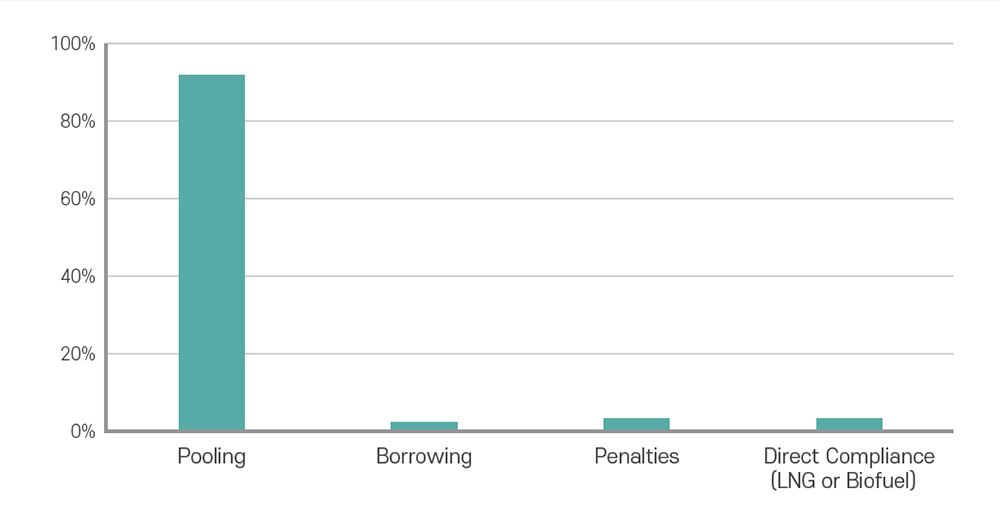
2025 FuelEU maritime compliance method selection / Credit: KR
KR also notes that repeated FuelEU Maritime penalty payments attract an additional 10% surcharge in consecutive years, making continued noncompliance a potentially more expensive strategy.
The report stresses that alternative-fuel investments should not be evaluated against pooling prices alone. Their economic value must also account for potential EU ETS savings, fuel characteristics and other regulatory obligations.
Compliance does not necessarily mean decarbonization
KR highlights that FuelEU Maritime’s first compliance cycle demonstrates that its market-based flexibility mechanisms can operate effectively, but also raises questions about the relationship between regulatory compliance and actual decarbonization.
While pooling enables shipping companies to satisfy their obligations at comparatively low cost, it does not necessarily require every participating vessel to reduce its own GHG intensity.
As FuelEU Maritime targets tighten, KR expects physical fuel transitions and capital investment to become increasingly important. The central challenge for shipowners will therefore be balancing immediate compliance savings with the longer-term investments needed to reduce emissions and remain competitive under progressively stricter regulations.
Source: Safety4sea
Robban Assafina is now on WhatsApp channel. Click Here