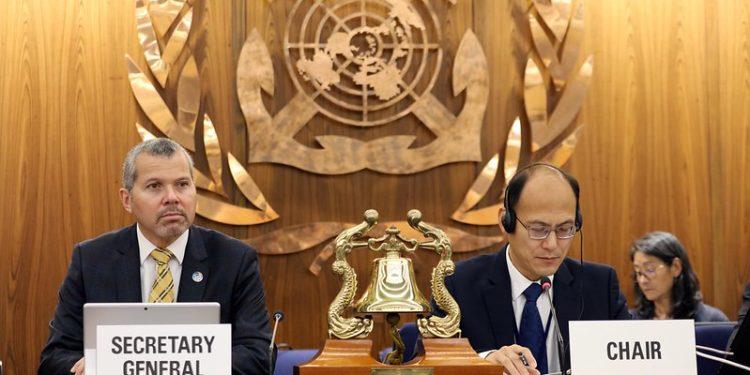
During the recent IMO III Sub-Committee, guidance on remote surveys, ISM audits, and ISPS verifications was finalized, and items related to the Industrial Personnel (IP) Code were added to the harmonized survey guidelines.
IMO also considered marine safety investigation reports, identifying parametric rolling, fire safety in self-unloading bulk carriers and inflatable lifejackets for consideration, DNV highlights in a recent update.
In addition, the Sub- Committee reviewed lessons learned from accident reports, finalized amendments to the survey guidelines under the Harmonized System of Survey and Certification (HSSC) and finalized amendments to procedures for Port State Control (PSC).Guidance on remote surveys, ISM audits and ISPS verifications were finalized, and the circular is expected to be approved by future sessions of the Maritime Safety Committee (MSC) and the Marine Environmental Protection Committee (MEPC).
What applies to remote surveys, ISM audits, and ISPS verifications
DNV highlights that portions of surveys may be carried out remotely, based on a risk assessment and the eligibility of the item for using remote methods.
However, remote surveys cannot be performed for two consecutive years for the same survey items. In all cases, the survey plan needs to be approved by the flag administration.
"Remote surveys are not accepted for SOLAS safety certificates and the International Load Lines Certificate for passenger ships."
ISM Code shipboard audits cannot be fully replaced by remote audits, and physical attendance will always be needed under normal circumstances.
Initial, renewal and interim company audits need physical attendance. Remote methods may be considered for annual audits and for interim audits when adding a new ship type to an existing Document of Compliance (DOC).
The performance of remote audits will need approval from the flag administration, and the audit plan needs to be sent well in advance to the flag administration for review and approval.
ISPS Code verifications can only under exceptional circumstances be carried out remotely, and only selected items are eligible for remote verification even in the exceptional circumstances.
III 11 considered the following lessons learned and follow-up items:
- Parametric rolling – forwarded to relevant Sub-Committees for consideration
- Fire safety in self-unloading bulk carriers – a Correspondence Group will develop a proposal for new output
- Inflatable lifejackets risks identified – a Correspondence Group will develop a proposal for new output
- Accidents related to falls, enclosed spaces, and rescue and survival craft – ongoing work noted
Harmonizing Port State Control (PSC) activities and procedures
III 11 finalized amendments to the “Procedures for Port State Control”.
"The revised consolidated PSC procedures, including amendments agreed at III 10 in 2024, are expected to be adopted at Assembly 34 in December 2025 and enter into force on 1 January 2026. " III 11 also discussed inconsistent application of ISM Code-related deficiencies across PSC regimes, and the development of objective criteria to assess manning levels.
No changes were made to the PSC procedures; however III 11 updated Model Course 3.09 on Port State Control.
Furthermore, III 11 finalized updates to the “Survey Guidelines under the Harmonized System of Survey and Certification (HSSC)”, and the “Non-Exhaustive List of Obligations under Instruments Relevant to the IMO Instruments Implementation Code (III Code)”. Both documents are expected to be adopted at Assembly 34 in December 2025 and enter into force on 1 January 2026.
The updated HSSC guideline includes provisions for the IP Code.Provisions related to the Anti-fouling System (AFS) Certificate were deleted, as the AFS Convention does not provide for a harmonized survey and certification system.