
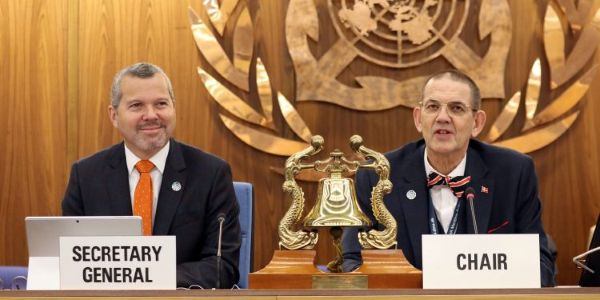
The twelfth session of the Sub-Committee on Ship Design and Construction (SDC 12) taking place on 19-23 January, convened as the first IMO meeting of 2026, marking the beginning of a new year of technical work with renewed momentum.
Delegates were welcomed to the session amid a global environment characterized by increasing geopolitical instability and growing challenges for international shipping. Those tensions are having a direct impact on maritime operations as conflicts affecting key regions. According to Arsenio Dominguez, Secretary-General, IMO, of particular concern is the human cost of these developments, especially their impact on seafarers, whose safety and wellbeing remain a central priority.
Against this backdrop, the Sub-Committee’s work was underscored as a shared responsibility to address the challenges facing international shipping and to develop effective solutions that enhance safety, security and resilience across the sector.
Furthermore, attention was drawn to the 2026 World Maritime Day theme, “From Policy to Practice: Powering Maritime Excellence.” As explained, the theme reflects the Organization’s commitment to ensuring that agreed regulations are effectively implemented and supported.
"The chosen theme intends to transmit a clear message of our commitment to ensuring regulations are put into action, and providing the necessary technical assistance for implementation to Member States. This ultimately strengthens the confidence that global rules agreed at IMO lead to safer, more secure and environmentally sound shipping worldwide."
…said Arsenio Dominguez.
The agenda for SDC 12 includes a number of significant technical and regulatory items, according to the Secretary-General:
Several matters are approaching completion, including the revision of the Explanatory Notes on Safe Return to Port, the development of Guidelines on the use of Remote Inspection Techniques (RIT) in Enhanced Survey Programme (ESP) surveys, and the revision of the Interim Guidelines on the use of Fibre Reinforced Plastic (FRP) in ship structures.
In addition, the Sub-Committee is expected to look ahead and plan future work on emerging technologies. Key among these are safety considerations for ships using new technologies and alternative fuels as part of global efforts to reduce greenhouse gas emissions.
Delegates are tasked with developing a roadmap addressing the safe use of nuclear power for ships, wind-assisted propulsion systems, and batteries, recognizing the importance of early planning in the successful development of regulatory frameworks.
The Sub-Committee will also consider the outcome of the intersessional Correspondence Group on Underwater Radiated Noise (URN). Concluding advice to the Marine Environment Protection Committee (MEPC) on the URN Experience Building Phase will be an important step toward promoting the uptake and application of the Revised URN Guidelines.
Maintaining excellence and fostering innovation require the Organization to keep pace with advances in ship design and marine engineering. The Sub-Committee continues to play a critical role in providing regulatory clarity and a robust safety framework for both conventional and emerging propulsion and steering systems.
The ongoing revision of SOLAS chapters II-1 (Part C) and V represents an important foundation for future work, aimed at enabling innovation while ensuring safe ship operations.
As the session progresses, confidence was expressed that the Sub-Committee, under the leadership of Chair Erik Tvedt of Denmark and Vice-Chair Charles Rawson of the United States, will address the issues before it effectively and achieve constructive outcomes, supported by the Maritime Safety Division and other IMO divisions.
Delegates were encouraged to engage fully in the week’s deliberations.


