
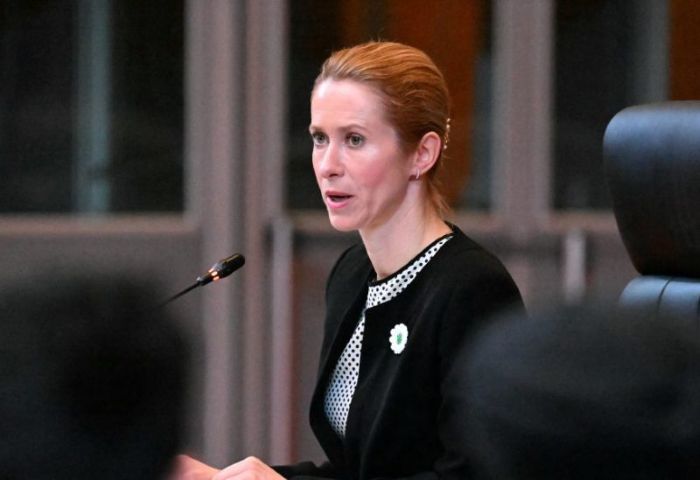
The head of the European Union's Foreign Policy Kaja Kallas on Monday said that the increasing tensions in the Strait of Hormuz underscored the urgent need for a "strong international coalition" to maintain maritime security, calling for a renewed global commitment to multilateralism and international law.
In his speech at the UN Security Council session on EU-UN cooperation in New York, Kallas said maritime routes were increasingly contested, with threats ranging from attacks on shipping lanes to sabotage of underwater infrastructure."What happened today in the Strait of Hormuz is the clearest call for a strong international coalition on maritime security. There are many initiatives being discussed, but the goal is simple: a safe route for all shipments through this route," Kallas explained, launching Anadolu (14/4).
Furthermore, he warned that global security, economic stability and energy supply are closely linked to maritime safety, noting that the region from the Baltic Sea to the Red Sea and the Indo-Pacific faces increased tensions.
He explained that the European Union would continue to reject any attempt to restrict freedom of navigation that violates international law, in particular the United Nations Convention on the Law of the Sea.
Kallas also pointed to what he described as the most serious violations of international law since World War II, mentioning two ongoing conflicts: the Russian-Ukrainian war and the war in the Middle East.
Tensions broke out in the Middle East on February 28, following a US and Israeli attack on Iran, which has so far killed more than 1,340 people, including the late Supreme Leader Ayatollah Ali Khamenei as well as a number of senior officials and military leaders.Analisis Geopolitik Iran
The State of the Mullahs retaliated by targeting Israeli territory and facilities related to the United States in a number of countries in the Middle East region. Israel also strictly restricts the Strait of Hormuz, through which one-fifth or about 20 percent of the world's oil and LNG traffic passes every day.
Tehran and Washington last week announced a two-week ceasefire, followed by talks over the weekend in Islamabad, Pakistan.
However, the negotiations, which also discussed Iran's nuclear program and the Strait of Hormuz, were deadlocked and failed to reach an agreement.
Robban Assafina is now on WhatsApp channel. Click Here


