
The European Maritime Safety Agency (EMSA) has released the Seafarer Statistics in the EU report, where it explores various statistics and trends regarding seafarers during the year 2024.
The report draws on data from certificates and endorsements registered by EU Member States, as well as Iceland and Norway, up to 31 December 2024.
The information was subsequently transferred to and recorded in the STCW Information System (STCW-IS) by 31 December 2025, providing a comprehensive snapshot of the European maritime labour market and the number of seafarers holding valid qualifications during 2024.According to the latest figures, 177,378 masters and officers held valid Certificates of Competency (CoCs) issued by EU Member States at the end of 2024. A further 136,660 masters and officers held original CoCs issued by non-EU countries that had been recognised through Endorsements attesting Recognition (EaRs) issued by EU Member States.
Taken together, these figures indicate that nearly 314,000 masters and officers were available to serve on board EU Member State-flagged vessels by the close of 2024, underscoring the scale of the maritime workforce supporting the European shipping industry.
The five EU Member States with the highest number of masters and officers holding CoCs issued by them in 2024 were, by order of magnitude:
- Norway,
- Poland,
- Croatia,
- Italy
- and Romania.
The five EU Member States with most masters and officers holding EaRs issued by them, also by order of magnitude, were:
- Malta,
- Cyprus
- Portugal
- Norway
- and Denmark.
Finally, the five non-EU countries which had more masters and officers holding CoCs recognised by EU Member States were the Philippines, Ukraine, the Russian Federation, India and Türkiye.
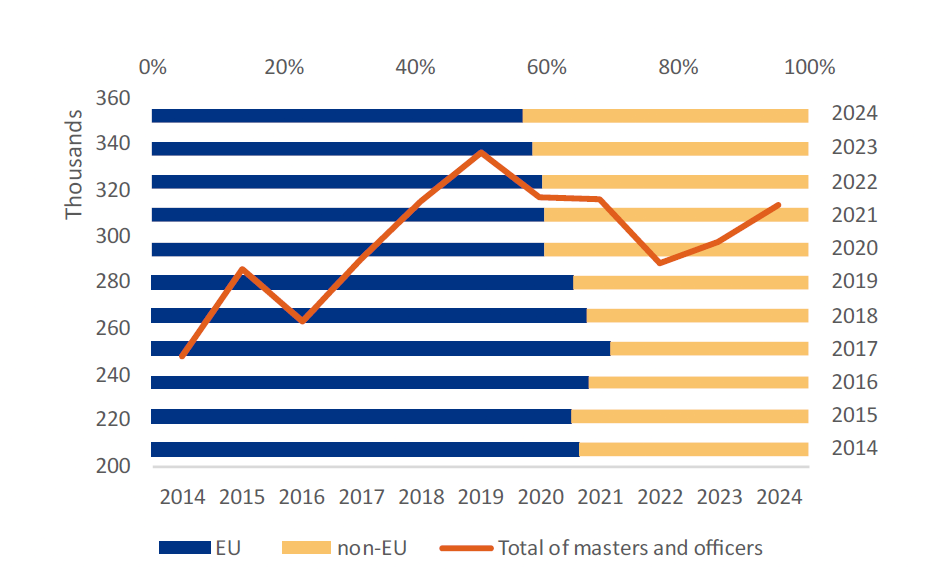
Masters and officers available at EU level over the years (EU and non-EU countries issuing the original certificate) / Credit: EMSA
A review of data covering the period 2014–2024 shows that the number of masters and officers holding Certificates of Competency (CoCs) and Endorsements attesting Recognition (EaRs), as well as ratings holding Certificates of Proficiency (CoPs), grew steadily between 2016 and 2019, expanding the pool of seafarers available to serve on EU Member State-flagged vessels.
That upward trajectory was disrupted between 2020 and 2022, largely due to the combined impact of Brexit and the COVID-19 pandemic. The sector has since shown signs of recovery, with modest increases recorded in both 2023 and 2024. Despite these fluctuations, the overall profile of the workforce has remained remarkably stable, with little change in the distribution of seafarers by country of certification, department, rank, gender or age.
The report also highlights a consistent demographic picture, with the age profile and geographic origins of seafarers remaining largely unchanged over the past decade. Women continue to represent a small minority of the officer workforce, with most female officers holding EU-issued certificates that qualify them to serve in the deck department.
While ongoing efforts to promote maritime careers and broader societal shifts are expected to encourage greater female participation in the profession, the pace of change remains gradual. As a result, women are unlikely to account for more than 2% of the global pool of masters and officers available to serve on EU Member State-flagged vessels in the near future.
Masters and officers holding valid certificates of competency in 2024
The total number of masters and officers holding valid CoCs at EU level was 177,378. Of these, 3.84% held CoCs entitling them to serve in both the Deck and Engine Departments.
In addition, just a very limited number of them (0.06%) held CoCs issued by more than one EU Member State, which had already been identified in previous reports, showing that not many changes have occurred during the last decade.
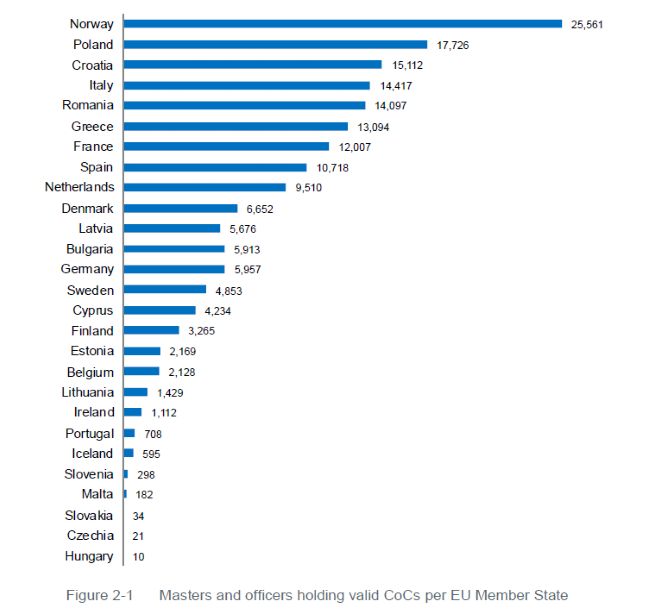
Distribution by EU Member State / Credit: EMSA
Gender distribution
The information on gender was available for 166,183 masters and officers, representing 93.69% of the total number of officers at EU level holding a CoC.
Considering the total number of masters and officers whose gender was known, it can be stated with a level of confidence of 99% that the percentage of female masters and officers was 2.83% ± 0.08% compared to 96.98% ± 0.08% of male masters and officers.
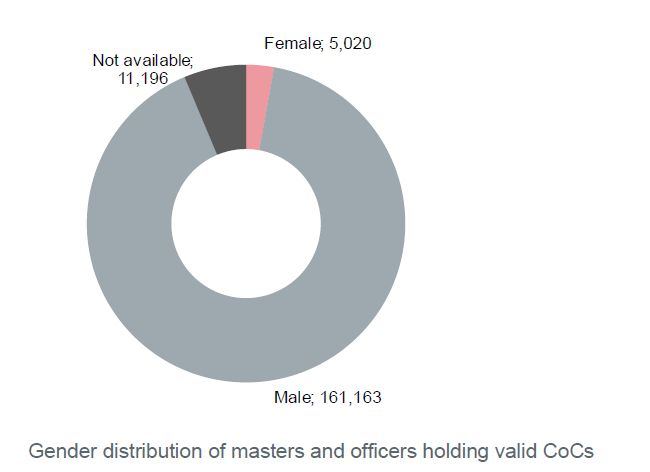
Credit: EMSA
The information presented shows that male masters and officers follow a general distribution by department (60% entitled to serve in the Deck Department and 40% entitled to serve in the Engine Department), while most female masters and officers (87.57%) were entitled to serve in the Deck Department.
Distribution by nationality
The information on nationality was available for 171,813 masters and officers, representing 96.86% of the total number of officers at EU level holding a CoC.
In addition to nationals of the EU Member States, 2,054 nationals of 89 non-EU countries held valid CoCs as masters or officers issued by EU Member States. When grouping these non-EU countries by region, it results that 17 were located in Europe, 20 in Asia, 30 in Africa, 23 in the Americas and 4 in Oceania.
The distribution of the non-EU nationals holding valid CoCs issued by the EU Member States presented shows that 66.80% of them were nationals of countries located in Europe.
Age distribution
The average age of masters and officers holding valid CoCs was 43.8 years. Whereas the under-25 age group counted 6,292 masters and officers, all other age groups had a relatively uniform distribution, each counting between 16,275 and 26,512 masters and officers, which represented 9% to 14% of the total number.
- 80.03% of officers holding certificates issued under Chapter VII, “Alternative certification”, of the STCW Convention were younger than 35 years of age;
- The masters and officers certified under Chapter II (Deck Department) and Chapter III (Engine Department) of the STCW Convention were evenly distributed throughout the age groups other than the 18–24 year age group;
- 56.31% of masters and deck officers and 54.08% of engineer officers were younger than 45 years of age.
Source: Safety4sea
Robban Assafina is now on WhatsApp channel. Click Here


