The European Maritime Safety Agency (EMSA) has published its Annual Overview of Marine Casualties and Incidents 2026, providing a decade-long assessment of maritime safety based on data recorded between 1 January 2016 and 31 December 2025.
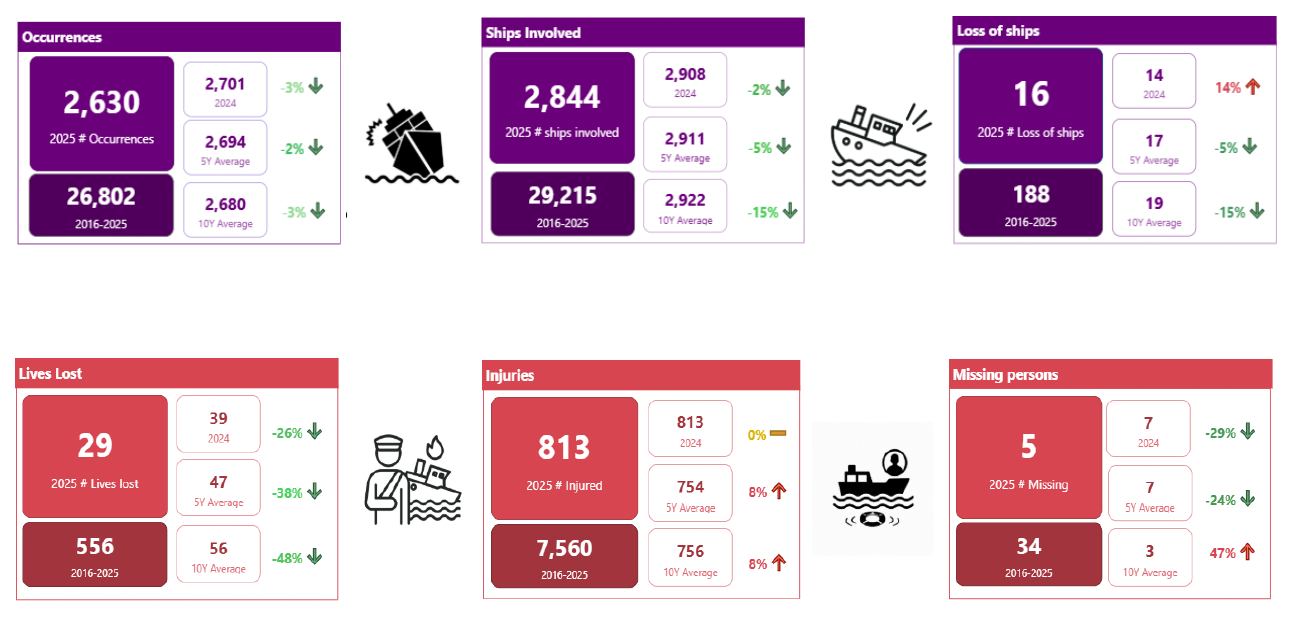
According to EMSA, a total of 26,802 marine casualties and incidents were recorded during the 2016–2025 period. In 2025, the number of reported occurrences stood at 2,630, approximately 2% below the ten-year annual average. These included 52 very serious casualties, among the lowest annual totals recorded over the period.The incidents reported in 2025 resulted in 29 fatalities, 813 injuries, five missing persons and the loss of 16 ships. While the number of lives lost fell to its lowest annual level in the decade under review, the number of injured persons remained comparatively high, highlighting the continued human impact of maritime accidents.
EMSA 2026 at a Glance
- 2,630 marine casualties and incidents recorded in 2025
- 2,844 ships involved in reported occurrences
- 52 very serious marine casualties recorded
- 29 lives lost – the lowest annual figure in 2016–2025
- 813 persons injured, remaining above the ten-year average
- 16 ships lost during 2025
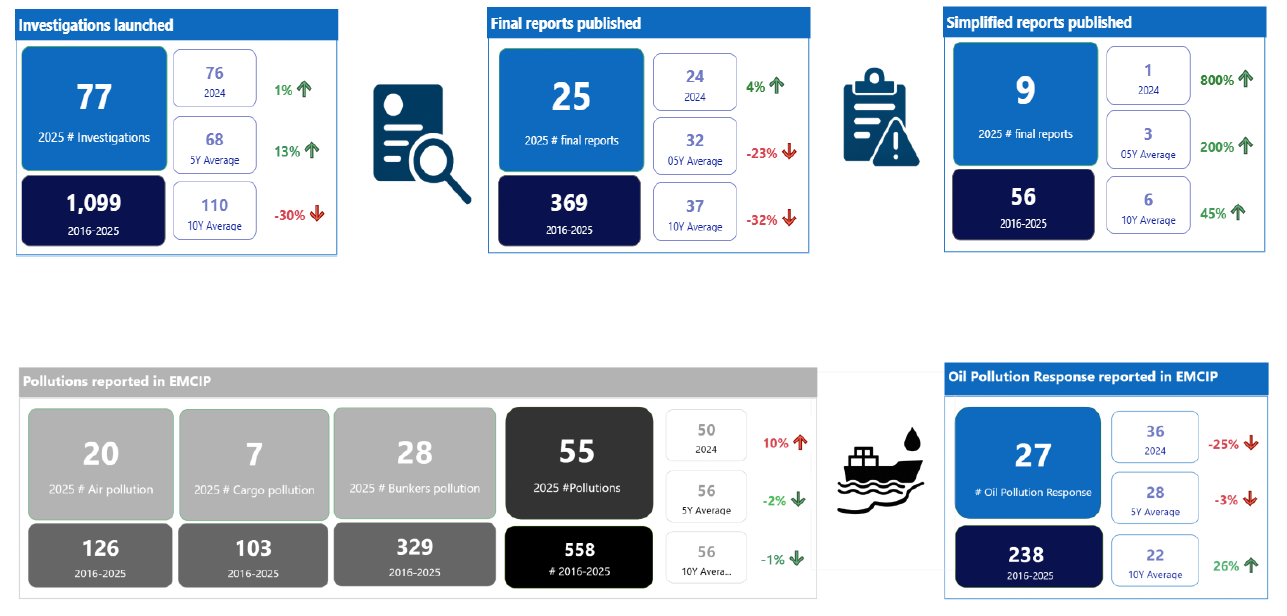
- 55 pollution occurrences reported, up approximately 10% from 2024
- 64% of classified accident events attributed to human action in finalised investigations (2016–2025)
The report draws on occurrences recorded in the European Marine Casualty Information Platform (EMCIP) by the safety investigation authorities of the 27 EU Member States, Iceland and Norway. It places the figures for 2025 in the context of trends observed over the preceding ten years.
Key figures:
Cargo and passenger ships account for the largest share of occurences
Cargo ships accounted for the largest share of marine casualties and incidents recorded over the 2016–2025 period, followed by passenger ships. At subtype level, solid-cargo ships represented approximately 38% of all occurrences, while conventional passenger ships and passenger/Ro-Ro cargo ships combined accounted for around 23%.
Ship age distribution varies by vessel type
The age profile of ships involved in reported occurrences was distributed across several age groups. Vessels aged 15–29 years formed the largest group among ships of known age, accounting for approximately 39% of occurrences over the 2016–2025 period. Their share rose to 45.5% in 2025.
Ships younger than ten years also represented a substantial proportion of occurrences. However, the age distribution varied by vessel type, with older ships more prominent among incidents involving fishing vessels and passenger ships.
Most occurrences recorded in internal waters
Marine casualties and incidents in 2025 were concentrated in areas of substantial maritime activity. Internal waters accounted for 52% of recorded occurrences, followed by territorial seas at 23% and the high seas at 21%.
These figures reflect the geographical distribution of reported occurrences rather than the relative risk associated with each area. Assessing geographical risk would require additional information on maritime activity and exposure, including vessel movements and time spent at sea.
Consequences to people
The number of lives lost in marine casualties and incidents continued to decline in 2025, reaching 29 fatalities — the lowest annual figure recorded over the 2016–2025 period. This marks a sustained downward trend from 95 fatalities in 2016. Over the decade, a total of 556 fatalities were reported, averaging 56 deaths per year. The five-year annual average for 2021–2025 fell further to 47 fatalities, while trend indicators show reductions of 39% over the past five years and 45% over the ten-year period.
The number of missing persons remained relatively low throughout the decade. No missing persons were reported between 2016 and 2021, before the figure rose to 16 in 2022. It subsequently declined to seven in both 2023 and 2024, reaching five in 2025.
In contrast to the decline in fatalities, injury figures remained comparatively high. Annual injuries fluctuated between 610 and 845 cases over the ten-year period, averaging approximately 765 per year. Following a low in 2020, the number of injuries increased and has remained above 800 annually since 2023. A total of 813 injuries were recorded in 2025, exceeding the long-term average and remaining close to the decade’s highest annual levels.
The figures point to a divergence in human consequences: although fatality numbers have fallen significantly, non-fatal injuries have not followed a comparable downward trend.
Loss of control among the most frequent ship-related events
Loss of control, particularly the loss of propulsion power, was the most frequently recorded detailed ship-related casualty event over the 2016–2025 period. Other recurring events included collisions, contact, equipment damage or loss, grounding or stranding, flooding or foundering, and fire or explosion.
Person-related casualty events were most commonly associated with falls, body movement and loss of control involving machinery, equipment or transport. The findings highlight the range of operational and human factors involved in maritime casualties.
Human action identified as the leading factor in finalised investigations
Investigation-derived findings provide a separate perspective on maritime safety, as not all reported occurrences undergo investigation and some investigations, particularly those relating to recent events, may remain incomplete.
Among 914 finalised investigations, Human Action accounted for approximately 64% of classified Accident Events, while system and equipment failure represented around 23%. Identified contributing factors included crew resource management, personnel and manning, maintenance, procedures and organisational issues.
Over the same ten-year period, investigations resulted in 1,316 safety recommendations, with 1,066 recorded actions taken. These addressed a range of areas, including operational procedures, training, communication, safety management, regulatory compliance and equipment reliability.
Shore assistance and emergency response patterns
Emergency-assistance patterns recorded in 2025 were broadly consistent with those observed over the preceding decade. Approximately 74% of ship records did not involve shore assistance, while search and rescue intervention was recorded in 9% and towage in 19%.
Oil-pollution response measures were activated in 27 occurrences during 2025, highlighting the environmental response dimension of maritime incidents alongside efforts to protect life and vessels.
Casualty ratios differ across ship types
The report’s contextual ratios reveal differing profiles across vessel categories. Passenger ships recorded comparatively high fleet-based occurrence and injury ratios, while cargo ships had the highest average fleet-based fatality ratio. Fishing vessels recorded the highest severity-profile ratio.
EMSA cautions that these ratios should not be interpreted as direct comparisons of operational risk or safety performance. The indicators do not fully account for differences in exposure between ship types, such as the number of voyages, time spent at sea, distance travelled or number of persons carried.
Such factors are essential for placing casualty statistics in context and drawing meaningful conclusions about maritime safety.
Safety recommendations
Over the 2016–2025 period, a total of 1,316 safety recommendations were recorded in connection with investigated marine casualties and incidents. These recommendations were associated with 421 occurrences, representing 11.11% of investigated cases.
Safety recommendations were primarily linked to more severe occurrences. Very Serious Casualties accounted for 54% of all recommendations over the decade, while Marine Casualties represented a further 44%. Recommendations arising from Marine Incidents accounted for only a small proportion of the total, reflecting the greater concentration of recommendations among more severe events.
Focus areas and contributing factors
Safety recommendations and the corresponding actions taken were classified into six focus areas: human factors, ship-related procedures, other procedures, ship structure and equipment, shore and water equipment, and other areas.
Ship-related procedures accounted for the largest share of recommendations, at 30%, followed by human factors at 23% and other procedures at 17%. Ship structure and equipment represented a further 14%, while the remaining recommendations concerned shore and water equipment, other areas or categories that were not specified.
At subcategory level, the most frequently identified themes included compliance with regulations and legislation, training, skills and experience, and company or organisational issues. Other recurring areas included operational safety and working practices, studies and reviews, information dissemination, management, crew-related factors and inspections. A substantial number of recommendations remained uncategorised.
Cargo ships account for the largest share of recommendations
Cargo ships generated the highest number of safety recommendations during the period, accounting for 54% of the total. Fishing vessels followed with 21%, while passenger ships represented 18%. Service ships and vessels classified as other or unknown accounted for smaller shares.
The distribution highlights the prominence of cargo shipping in the overall number of recommendations recorded through marine casualty investigations between 2016 and 2025.
Source: Safety4sea
Robban Assafina is now on WhatsApp channel. Click Here