Black Sea MoU has published a report with key results from the Concentrated Inspection Campaign (CIC) on Ballast Water Management conducted in 2025.
From 1 September 2025 to 30 November 2025, the Black Sea MoU carried out a Concentrated Inspection Campaign (CIC) on Ballast Water Management. The campaign was conducted by Member Authorities of the Black Sea MoU that have ratified the International Convention for the Control and Management of Ships’ Ballast Water and Sediments, 2004 (BWM Convention).
It was conducted in conjunction with the Paris and Tokyo Memoranda and coordinated by the Maritime Administration of Türkiye. The guidelines and questionnaires jointly developed by the Paris and Tokyo MoUs were used throughout the campaign.
Previously, in February, Black Sea MoU had also published the preliminary results of CIC on Ballast Water Management.
Scope and methodology
The CIC applied to all ships, with each vessel subjected to only one inspection during the campaign period. A total of 775 inspections were carried out by the member authorities of the BS MoU that are party to the BWM Convention, covering 736 individual ships. Of these, 624 inspections were conducted using the CIC questionnaire.
Overall inspection outcomes
During the campaign, 76 ships were detained. Of these, 52 detentions resulted from inspections using CIC questionnaires, and 16 were directly attributed to CIC-related deficiencies.
Questionnaire compliance results
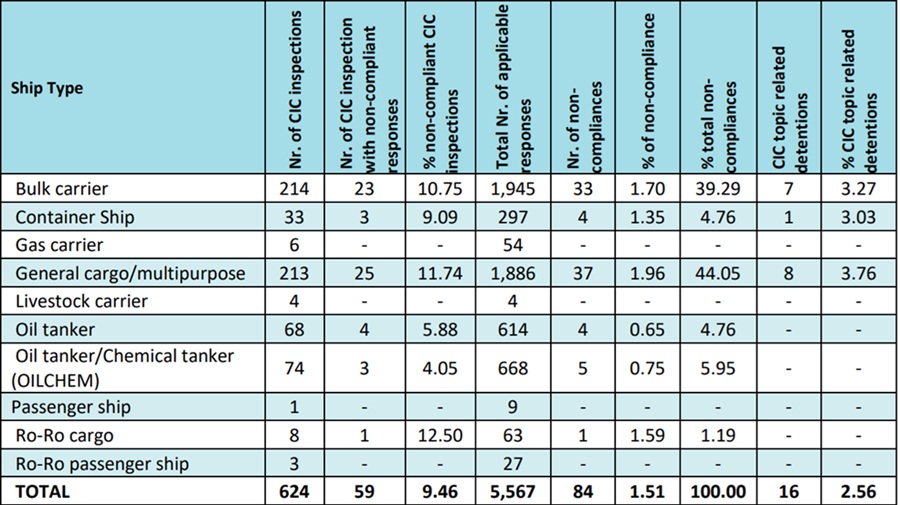
A total of 59 questionnaires recorded at least one non-compliance response, representing 9.46% of CIC inspections. The overall average non-compliance rate was 1.51%, reflecting the proportion of unsatisfactory answers across all applicable questionnaire items.
Key areas of non-compliance
The analysis shows that approximately 89.3% of all recorded non-compliances were concentrated in three main areas:
- Operational condition of Ballast Water Management Systems (BWMS)
- Proper completion of the Ballast Water Record Book (BWRB)
- Crew familiarization with the Ballast Water Management Plan (BWMP)
Among these, BWMS operability was the most significant issue, accounting for the highest number of non-conformities and the largest share of CIC-related detentions.
According to Tokyo MoU’s preliminary results, the most common deficiencies (and deficiencies that resulted in a detention) found during the campaign were also associated with under the deficiency code 14811 (Q6 – Is the BWMS operational?).
In addition, RISK4SEA’s data on the CIC indicated that over 90% of all findings are concentrated in just four areas:
- Ballast Water Record Book (BWRB)
- Ballast Water Management System (BWMS)
- Ballast Water Management Plan (BWMP)
- Crew Training & Familiarization
Ship types inspected and detained
Bulk carriers accounted for 214 inspections (34.3%), followed by general cargo/multi-purpose ships with 213 inspections (34.1%), oil/chemical tankers with 74 inspections (11.9%), and oil tankers with 68 inspections (10.9%). These four categories totaled 569 inspections (91.2% of all CIC inspections).
CIC-related detentions were recorded on general cargo/multi-purpose ships (8 detentions), bulk carriers (7 detentions), and one container ship.
Flag state distribution
Ships registered under 46 flag states were inspected during the campaign. The highest number of inspections were conducted on ships registered in Panama (117 inspections, 18.8%), Liberia (97 inspections, 15.5%), and the Marshall Islands (43 inspections, 6.9%).
CIC-related detentions involved ships flying the flags of Barbados (3), Belize (1), Liberia (2), Palau (1), Panama (3), Saint Kitts and Nevis (4), Tanzania (1), and Vanuatu (1).
Age and risk profile findings
Vessels aged between 15 and 25 years accounted for the majority of CIC-related detentions. In addition, High Risk Ships (HRS) recorded significantly higher non-conformity rates compared with Standard and Low Risk Ships.
Conclusions
The CIC results indicate a very high level of compliance with certification, approval of the BWM Plan and BWM System, and ballast water sediment management. Nevertheless, the CIC related detention rate of 2.56% highlights the need for continued attention to certain operational and procedural requirements.
In particular, the results suggest that further improvements are required in relation to the implementation of exemption conditions, proper completion of the Ballast Water Record Book, operational reliability of the Ballast Water Management System, and crew familiarization with BWMP procedures.
Robban Assafina is now on WhatsApp channel. Click Here